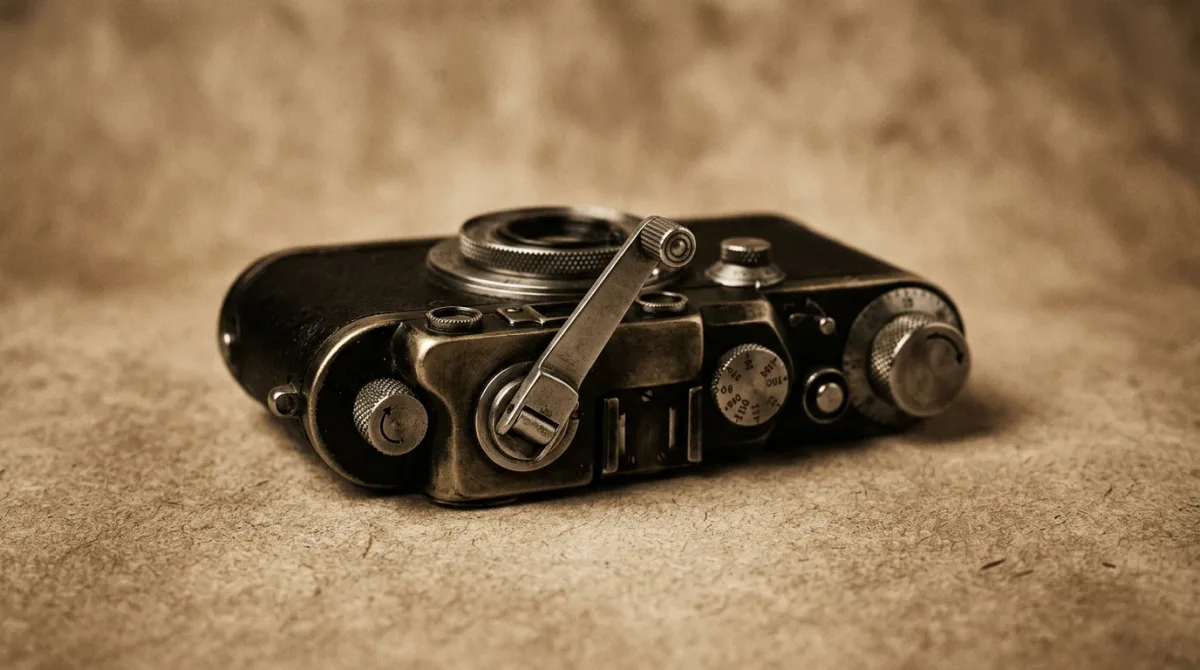
The Pentax 17 is Ricoh's new half-frame 35mm film camera, and its whole pitch fits on a spec sheet: a fixed 25mm f/3.5 lens, six zone-focus settings instead of autofocus, and — because each frame is half the usual size — roughly double the exposures on a standard roll, all for $499.95, per Ricoh's own specifications.
That arithmetic is the whole argument for half-frame, and it's worth taking seriously before getting into how the camera actually handles. A camera that doubles your frame count without asking you to buy more film changes the economics of shooting, especially for anyone who has watched a roll of Portra climb in price over the last few years.
| The Object Row | |
|---|---|
| Camera | Pentax 17 |
| Maker | Ricoh Imaging (Pentax) |
| Year | 2024 |
| Format | Half-frame 35mm, 24×17mm exposure |
| Price | $499.95, listed by Ricoh's US store as of August 2026 |
| Basis of coverage | Ricoh's official specification sheet and launch announcement; PetaPixel's published hands-on review |
What Half-Frame Actually Means Here
A standard 35mm frame measures 36×24mm. The Pentax 17 exposes a 24×17mm frame instead, turned sideways, so a roll loaded for 36 exposures yields close to double that count, according to Ricoh's specification sheet. The lens is fixed: a newly built HD Pentax optic at 25mm, equivalent to roughly 37mm once the smaller frame is accounted for, with three elements in three groups and an f/3.5 maximum aperture. Shutter speeds run electronically from 1/350 second down to four seconds, plus a Bulb setting, and sensitivity is set manually across ISO 50 through 3200 in the increments printed on modern film boxes — 50, 100, 125, 160, 200, 400, 800, 1600, 3200.
None of that is a spec-sheet abstraction once you're loading film, because every one of those numbers is a dial or a lever on the body, not a menu. Ricoh's own launch materials frame the camera around that kind of hands-on operation rather than automation, quoting Ken Curry, president of Ricoh Imaging Americas, in the company's launch announcement:
"Many photographers were first introduced to photography using a PENTAX film camera. We're hoping to introduce a new generation to film photography with the PENTAX 17."
Design and Handling
The body is small and dense — 127mm wide, 78mm tall, 52mm deep, and about 290 grams without film or battery, built around a magnesium alloy chassis, per Ricoh's specifications. Film advance is entirely manual: a winding lever with a 130-degree stroke and a 35-degree stand-off angle, paired with a manual rewind crank so a roll can be pulled mid-roll if needed. That lever is the part of the camera reviewers keep coming back to. PetaPixel's hands-on review called it a highlight of using the camera day to day, writing that "the thumb winder has a short throw and is so much fun to use," and noted the build quality generally exceeded expectations for the price, even though some external components felt plasticky and there's no weather sealing to speak of.
Framing runs through an Albada-type bright-frame viewfinder — an optical window with projected lines rather than through-the-lens focusing — and the same window doubles as the zone-focus confirmation display, showing which of the six distance settings is active as you turn the focus ring.
The Zone-Focus System, in Practice
There is no autofocus and no focus-by-distance-estimation guesswork beyond the marked zones. Ricoh's spec sheet lists six: 0.25m, 0.5m, 1.2m, 1.7m, 3m, and infinity, confirmed through the viewfinder as you rotate the ring. It's the single biggest thing a shooter coming from an autofocus point-and-shoot or a phone has to adjust to, and it's also the part PetaPixel's reviewer was most skeptical of going in. That skepticism didn't hold up in practice: the reviewer described the system as "quite easy to use as long as I formed a routine of checking it regularly," and reported being "pleasantly surprised" by how often the zones landed a shot in focus. The tradeoff, per that same review, is that the camera gives no readout of aperture or shutter speed once a shot is framed, so there's no way to double-check exposure decisions the way a meter-equipped SLR allows — the shooter is trusting the camera's automatic metering, or trusting nothing at all.
Results, as Reviewers Have Reported Them
Shot on stock like Kodak Portra 400 and Ilford FP4 Plus, the lens produced images PetaPixel's review described as decently sharp with good flare resistance, though the smaller half-frame negative carries the tradeoffs that format implies: the review noted that "the half-frame images will be grainy and often a little washed out" compared with full-frame 35mm, and that the camera struggles in high-contrast scenes where the metering has to guess at a single exposure for a wide brightness range. The built-in flash, rated by Ricoh at a guide number of approximately 6 at ISO 100 with roughly nine seconds to recharge, drew similar criticism in that review for producing harsh, uneven light — useful as a fill in a pinch, not a tool for anything more demanding.
None of that reads as a camera failing at its job. It reads as a camera that was built around specific constraints — fixed lens, zone focus, no exposure readout — and mostly delivers what those constraints promise: a compact, manually operated body that gets more frames out of a roll and asks the shooter to make peace with imprecision in exchange.
What It Costs to Shoot
The Pentax 17 launched at $499.95 in 2024, and that's still the listed price on Ricoh's US store as of August 2026 — a rare case of a new film camera holding its launch price rather than climbing with it, though film and processing costs on top of the body are a separate, ongoing expense that this guide isn't pricing out. Because a half-frame roll yields close to double the exposures of a standard 35mm roll, the effective cost per frame for film and processing drops accordingly, even though the body itself isn't cheap by point-and-shoot standards.
Who Should Buy One
Per PetaPixel's review, the camera is aimed most directly at first-time film shooters and people moving over from smartphone photography who want an authentic, hands-on introduction without a steep manual-exposure learning curve — the zone focus and automatic metering do real work handling the parts a beginner would otherwise fumble. Shooters who want full manual control over aperture and shutter speed, or who need to verify exposure before pressing the shutter, are the ones the reviewer flagged as being underserved by the fixed lens and blind metering. For anyone in between — an experienced shooter who wants a compact, doubles-your-roll travel camera and doesn't mind giving up manual control for it — the tradeoffs the Pentax 17 makes are consistent and clearly documented, which is more than can be said for most cameras at this price point.
For a related cameras perspective, read The Pentax 17 Is Proof Zone Focusing Never Went Out of Style.
For more context, read The Pentax 17 Is Proof Zone Focusing Never Went Out of Style.