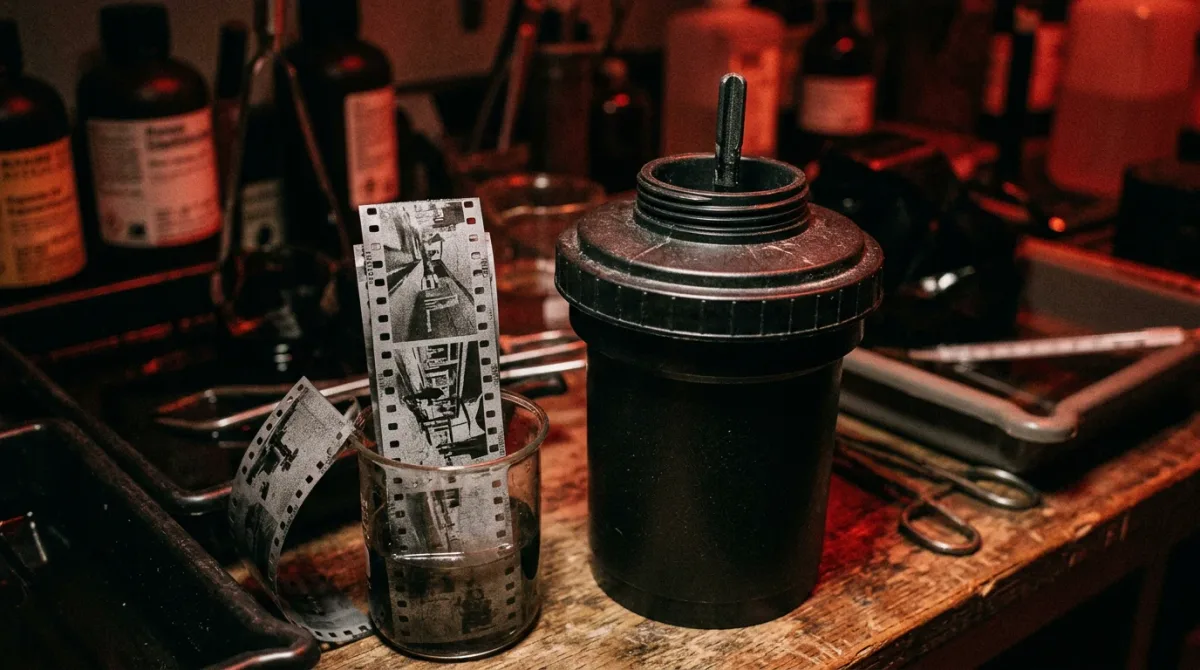
Pushing Kodak Tri-X 400 two stops to EI 1600 is the push almost any darkroom shooter can pull off cleanly: Kodak's own datasheet calls for about six minutes in HC-110 Dilution B at 68°F, up from three and three-quarter minutes at box speed, trading a bump in contrast and grain for two stops of usable light.
Tri-X has carried that reputation for decades because the film simply doesn't fall apart when it's underexposed and overdeveloped. One writer on Tri-X's history quoted a crew member who put it bluntly: "you can push that stuff so far it comes round the other side." That reputation is why Tri-X, not a faster stock, is still the default answer when a shooter needs another two stops after dark.
What does it mean to push Tri-X two stops?
A two-stop push means setting the camera's meter to EI 1600 instead of the box speed of 400, underexposing every frame by two full stops, and then compensating in the developer by extending development time. Kodak's Professional Tri-X 400 datasheet spells out the trade at each stop: a one-stop push to EI 800 uses normal processing time and costs "a slight loss in shadow detail," while the two-stop push to EI 1600 requires longer development and brings "an increase in contrast and graininess." A three-stop push to EI 3200 pushes the shadow loss further still. The two-stop point sits in the middle — enough extra speed to matter, without the shadows falling out of the frame.
How much do I actually change in the developer?
For HC-110 Dilution B at 68°F (20°C) in a small tank with agitation every 30 seconds, Kodak's chart lists normal development at three and three-quarter minutes for EI 400 and roughly six minutes for the EI 1600 push — almost 60% longer in the tank for two stops of speed. Every developer and dilution has its own chart, and Kodak's own published numbers don't extend to a three-stop push in HC-110(B) the way they do for one and two stops, which is itself a signal about where the film starts to strain.
What will the negatives look like at EI 1600?
Grain and contrast both move, and they move together. Tri-X's grain has never been smoothed out the way some modern black-and-white stocks are, and pushing makes that texture more pronounced rather than introducing a new kind of noise — photographers now shoot the film deliberately for that organic grain instead of avoiding it. Contrast climbs too: the film holds what's been called a "chalk-and-charcoal" look at box speed, and a two-stop push sharpens that split between highlights and shadow rather than softening it. Shadow detail is the part that actually disappears — Kodak's own language for the two-stop push doesn't even promise "slight" loss the way it does at one stop, so expect deeper blacks with less information sitting in them.
A useful data point on how far that trade can be pushed comes from a photographer who took Tri-X to EI 6400 — a four-stop push, twice as aggressive as the one this guide covers — using Ilford DD-X diluted 1+4 for 25 minutes, with one minute of initial agitation followed by four inversions per minute. The verdict on that result: the film had been pushed "a little too far," with shadow detail loss significant enough to be the defining flaw of the roll, even though the frames stayed usable. That's a useful marker for where a two-stop push sits by comparison — EI 1600 is closer to Tri-X's comfortable range than to its breaking point.
Step by step: shooting and developing a two-stop push
- Load Tri-X and set the camera's meter (or your handheld meter) to EI 1600 for the entire roll — mixing box-speed and pushed frames on one roll means picking one development time that won't be right for both.
- Meter for the shadows where you can. Because the two-stop push loses shadow detail rather than blowing out highlights, exposing generously for the dark areas of the frame protects the part of the negative that's under the most stress.
- Develop in HC-110 Dilution B at 68°F (20°C) for approximately six minutes, agitating every 30 seconds in a small tank, per Kodak's own processing chart for the EI 1600 push.
- Follow with a normal stop bath, fix, and wash — the push changes development time only, not the fixing or washing steps.
- Expect denser highlights and a more graphic, higher-contrast negative when it's dry; that's the film behaving as documented, not a sign something went wrong.
Mistakes that ruin a two-stop push
The push fails for predictable reasons, not mysterious ones. Underexposing for EI 1600 but developing for normal EI 400 time leaves a thin, muddy negative because the extra development is what recovers the density the shorter exposure didn't lay down. Metering for highlights instead of shadows on a pushed roll throws away the part of the negative that already has the least information to spare. And treating every stop of push as equally survivable ignores what Kodak's own chart already shows: the jump from one stop to two costs more shadow detail and more contrast than the first stop did, and going further still, as the four-stop EI 6400 test showed, moves the film out of its comfortable range entirely.
FAQ
- Can I push Tri-X further than two stops? Kodak's datasheet documents a three-stop push to EI 3200 with additional shadow-detail loss beyond the two-stop result, and a published four-stop test at EI 6400 in Ilford DD-X produced usable but noticeably compromised negatives — further pushes are possible but trade away more shadow detail each time.
- Does pushing require a different developer than HC-110? No — Kodak's own chart covers pushed Tri-X in HC-110 Dilution B, and other developers such as Ilford DD-X have also been used for aggressive pushes; each developer and dilution needs its own time, so check a chart for the specific combination rather than reusing HC-110 times elsewhere.
- Will a two-stop push blow out my highlights? Kodak's own description of the two-stop push points to increased contrast and graininess plus shadow-detail loss, not blown highlights — the part of the negative that suffers most is the shadows, not the bright areas.
- Does pushing permanently change how grainy Tri-X looks? Only for that roll's development — push processing increases visible grain by extending development time for those specific frames, and shooting the next roll at box speed and normal development returns the film to its standard look.
For a related photography news perspective, read Ben Affleck and Matt Damon Make a Splash on Gossip Stone TV.
For more context, read How to Push Tri-X Two Stops Without Ruining It — Film.
For more context, read How to Push Tri-X Two Stops Without Ruining It.
For more context, read How to Push Ilford HP5 Plus to 1600 Without Ruining It.