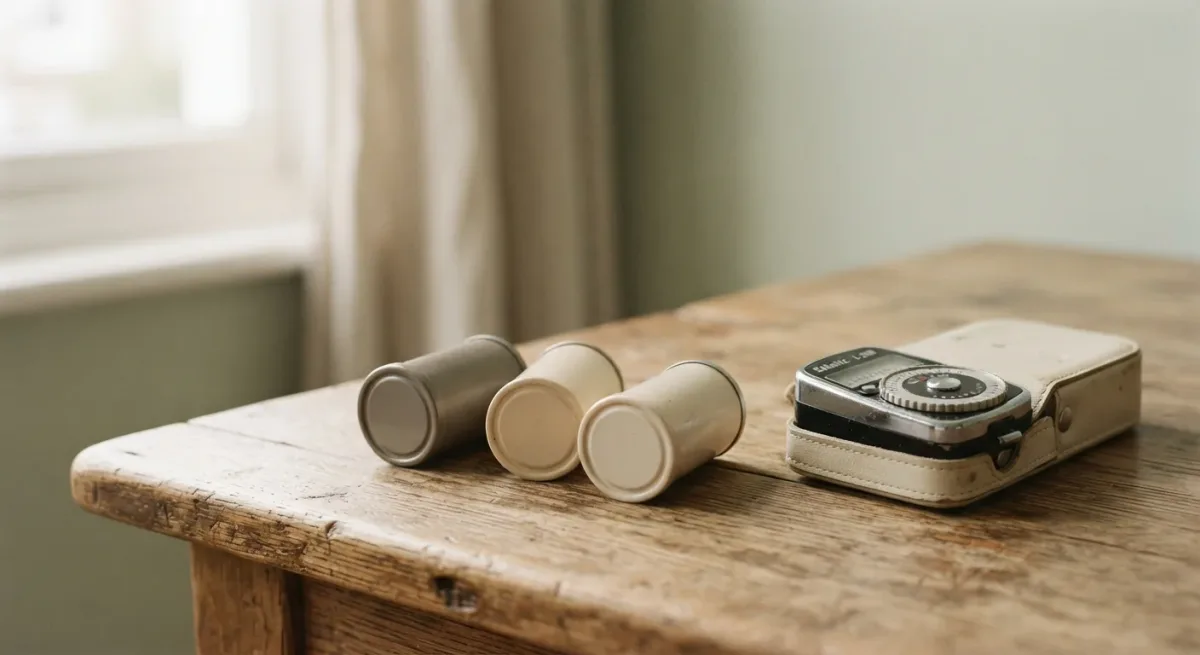
Portra 400 is the most forgiving color negative film in current production: Kodak's own datasheet rates it at 400 with a documented exposure latitude wide enough to shoot it at 200, 100, or effectively anywhere overexposed up to two stops without a development change, and the professional results community has spent two decades treating that tolerance as the stock's whole identity. The catch is the price — roughly $14-16 per 36-exposure roll at major US retailers as of early 2025, several dollars above its consumer siblings. Forgiveness costs money.
This guide is built from Kodak's published datasheet and named published coverage; no roll was shot for it, and nothing here claims one was.
What does the datasheet actually promise?
Three documented claims from Kodak's PORTRA 400 professional datasheet. Latitude: the film's emulsion design delivers usable density across a wide exposure range, with overexposure tolerance emphasized — the practical reading, echoed in published lab and shooter coverage, is that rating it at 200 or 100 and developing normally produces pleasing, printable negatives rather than fogged ones. Color character: the stock is described as a natural-color portrait emulsion, fine-grained for its speed, and the results community reads its palette as warm-neutral with restrained saturation — the "Portra look" that digital presets have spent years imitating. Scan behavior: the datasheet's characteristic curves are designed for scanning workflow, and lab workflow guides describe it as a stock that forgives scanner operators the way it forgives meters.
Why does overexposure tolerance matter so much in practice?
Because color negative film's failure mode is underexposure, and most shooting errors run the other direction. A roll that looks good when you forget to reset the meter after a late-afternoon setting, when you shoot backlit and the meter reads the sky, when you point a cheap camera's limited shutter at shade — that roll survives the real world. Published shooter coverage has made this point for years: Portra 400 overexposed by a stop or two tends to render slightly softer, warmer, with shadow detail intact, while the same error on a slide film like Ektachrome destroys the frame. Forgiveness is not a vibe. It is a documented characteristic-curve shape, and it is the reason the stock became the default for weddings, travel, and anyone shooting a meterless camera.
What is the working character, per published results?
Collected from named coverage and Kodak's own samples: grain is fine for a 400-speed emulsion, visible in flat light but not the subject of the photograph; skin tones are the stock's advertised center of gravity, with the palette leaning warm-neutral rather than the cooler magenta cast of some older emulsions; and flash workflow is simple, with the latitude covering the distance errors that manual flash produces. In mixed light, published results show the stock leaning warm under tungsten and staying remarkably neutral in open shade — the two conditions portrait shooters actually work in.
When should you shoot something cheaper?
The honest segmenting, prices as of early 2025 and moving — always check the current shelf price:
| If you're shooting… | Better value | Why, per the documentation |
|---|---|---|
| Full sun, controlled light, plenty of frames | Gold 200 or Ultramax 400 | Consumer stocks deliver similar warmth at roughly half the price; latitude matters less when the light is stable |
| Deliberate two-stop overexposure experiments | Still Portra 400 | The latitude is the product; cheaper stocks crowd faster |
| Scans you'll grade heavily anyway | Ultramax 400 | If the grade is the look, pay for frames, not palette |
| Slide-film punch | Ektachrome E100 | Different technology, tighter latitude, stronger saturation — the opposite trade |
Who is Portra 400 for, in the end?
For the shooter whose conditions vary — the travel day that starts in a hotel lobby and ends on a beach; for the meterless-camera owner who needs the emulsion to absorb the exposure guess; for anyone paying for a lab scan of an unrepeatable day. It is not for the budget roll, and it is not the punchiest stock on the shelf — it is the one that comes back usable from the widest range of situations, and Kodak's datasheet has been quietly promising exactly that for its entire production run. The community's devotion is just the documentation, experienced.
For more context, read How to Push Tri-X Two Stops Without Ruining It — Film.