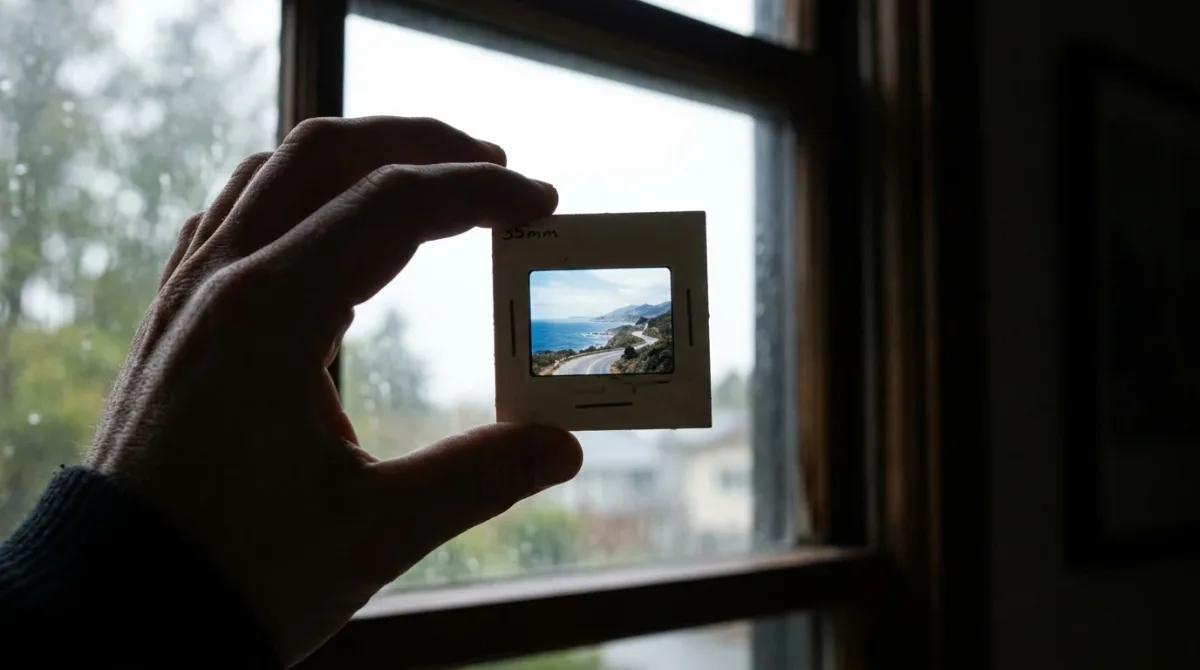
Kodachrome was rated at ASA 12, and the person who shot it could not develop it. Every exposed roll went back to the manufacturer in Rochester, New York, and the Library of Congress's own account of its Depression-era color files says that round trip added about two weeks. The picture was made in the camera. It was finished somewhere else.
That single fact explains almost everything about the film: why it was slow, why it was rare in the field, why its color looked unlike anything a local lab could hand back, and why, in the end, it could not survive. Kodachrome was never really a product you bought. It was a product plus a factory, sold together, and when the factory went the film went with it.
Two musicians who would not let it go
The film began as a hobby that got out of hand. According to the University of Michigan School of Music, Theatre & Dance, Leopold Mannes and Leopold Godowsky Jr. were teenagers in 1918 when they sat through a Navy documentary shot in a two-color process, decided the color was not good enough, and started experimenting with filters themselves.
Neither of them was a chemist by trade. Godowsky's father was a well-known pianist and composer; Mannes's parents founded the Mannes School of Music in New York. Godowsky studied violin at UCLA while also taking physics and chemistry, and Mannes read piano at Harvard alongside physics and composition studies in Italy, the school's account notes. They kept the music and kept the experiments running in parallel, and in 1922, while Mannes was in Europe, he found a partner at an investment bank willing to fund the color work.
The turn came in 1930, when the Eastman Kodak Company invited the pair to continue their research at its Rochester headquarters and aim at a three-color process. Godowsky, by then married to Frances Gershwin — George Gershwin's youngest sibling — moved to Rochester with her. Five years later the result went on sale: Kodachrome, described by the school as the first modern multilayer color transparency film, arriving in 1935 with a processing sequence of 28 steps that only the manufacturer could run.
What ASA 12 actually cost a working photographer
Twenty-eight steps in a factory is an abstraction. The practical version of it shows up in the notes the Library of Congress keeps on the color work of the Farm Security Administration and the Office of War Information, the government photography units that documented American life through the Depression and into the war.
The background document for that collection is blunt about why the FSA photographers shot so little color. Kodachrome had, in its words, "a slow film speed of only ASA 12, making it useful for only outside photography." The film "had to be sent to Kodak in Rochester NY for processing," which meant "an additional two weeks to get the negatives returned" — and because the photographers were traveling, they often would not see the results "for perhaps a month or two, long after they had left the area."
Read that as a working constraint rather than a spec. A photographer in the field could not review a color frame, could not adjust, could not reshoot. Whatever the meter said at the moment of exposure was the entire decision, and the answer arrived weeks later in another state. There was also nowhere to put the pictures: the same document notes that magazines and newspapers were not printing color at that time, so the color rolls were, in a commercial sense, work nobody had ordered.
The object row
| Field | Detail |
|---|---|
| Film | Kodachrome |
| Maker | Eastman Kodak Company |
| Year | Released 1935, per the University of Michigan School of Music, Theatre & Dance |
| Format | 35mm slides, with related color transparencies in the FSA/OWI files running in sizes up to 4x5 inches, per the Library of Congress |
| Speed | ASA 12, per the Library of Congress background document on the FSA/OWI color photographs |
| Processing | Manufacturer only; 28 steps, per the University of Michigan account |
| Price | Not established by the sources cited in this article |
| Basis of coverage | Library of Congress collection documentation, the University of Michigan School of Music, Theatre & Dance account of the inventors, and NPR's reporting on the end of processing. No test roll was shot for this piece. |
The archive that shows what the film could do
The strongest surviving argument for Kodachrome is not a marketing claim. It is a public archive anyone can open.
The Library of Congress holds the FSA/OWI color photographs, and its catalogue description of the collection is specific about the material: "Most of the color images are 35mm Kodachrome slides; a few are color transparencies in sizes up to 4x5-inches." The OWI portion alone accounts for 965 color photographs. Compared with the black-and-white side of the same project, it is a sliver — the library's Picture This blog puts the color group at about 1,600 images against roughly 175,000 black-and-white negatives from the same effort, covering American life from 1939 into the mid-1940s.
That ratio is the point. Color was the exception, shot by photographers who had to justify every frame of it, on a film so slow it pinned them to daylight. What came back is a version of the 1930s and 1940s that does not look like history at all, because the eye reads black and white as the past and reads color as now. The Library of Congress's background notes on the collection describe how narrow that window was; the pictures themselves are the receipt.
Why a mail-in film was always going to go first
A film that depends on a single proprietary process has a failure mode built into it. Black-and-white stock can be developed in a kitchen with three chemicals; C-41 color negative runs in thousands of labs. Kodachrome ran where the manufacturer said it ran, and nowhere else.
So the ending, when it came, was a logistics ending rather than an aesthetic one. NPR reported in December 2010 that the final roll would be developed that Thursday by Dwayne's Photo, a studio in Parsons, Kansas — the last place on earth still running the process — 75 years after Kodak released what the network called the world's first consumer color film. In NPR's summary, Kodachrome "was an enormous hit because of how vividly it reproduced colors," and the thing that killed it was the digital shift, not any failure of the film.
Note what did not happen. Nobody found a way to keep the film alive independently, the way small operations have revived other discontinued stocks by rebuilding a coating line or reformulating a developer. There was no home-brew Kodachrome, no boutique lab that picked up the process. The chemistry was the company, and the company had moved on.
What to take from it now
For the shooter who wants the look: there is no version of this you can load into a camera, and any preset promising the palette is doing something else. The honest route is the archive. Spend an evening in the Library of Congress color files, work out what actually reads as Kodachrome to your eye, and then chase that with a modern transparency film and daylight discipline rather than a slider.
For the shooter who wants the lesson: ASA 12 and a two-week mail round trip produced some of the most-looked-at color photographs in American history. The constraint was not incidental to the work — it forced photographers to commit, in daylight, to one frame at a time, with no feedback loop at all. Most of us shoot with more latitude than that and less resolve.
And for anyone weighing a film stock today, Kodachrome is a useful question to keep in the back pocket: who else can process this, and what happens to my pictures when they stop? A film you can develop yourself, or hand to any lab in town, is a film that can outlive the company that made it. Kodachrome could not, and that is the one thing about it nobody misses.
For a related darkroom perspective, read How Long Should You Wash Film Negatives After Fixing?.