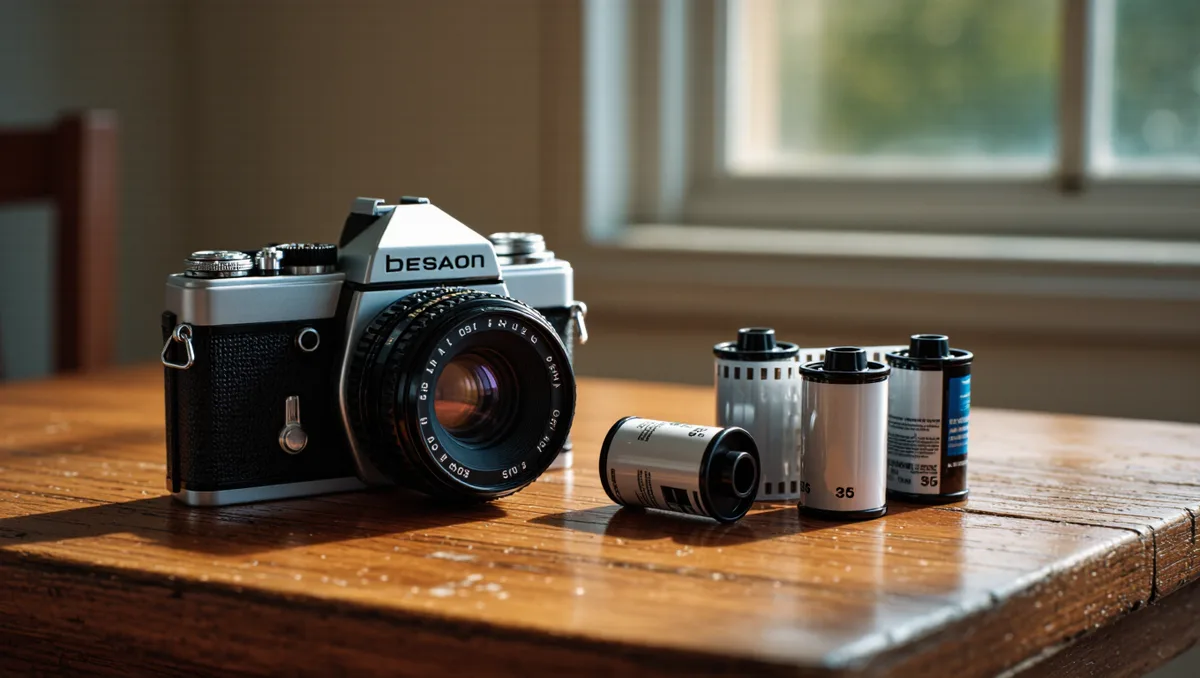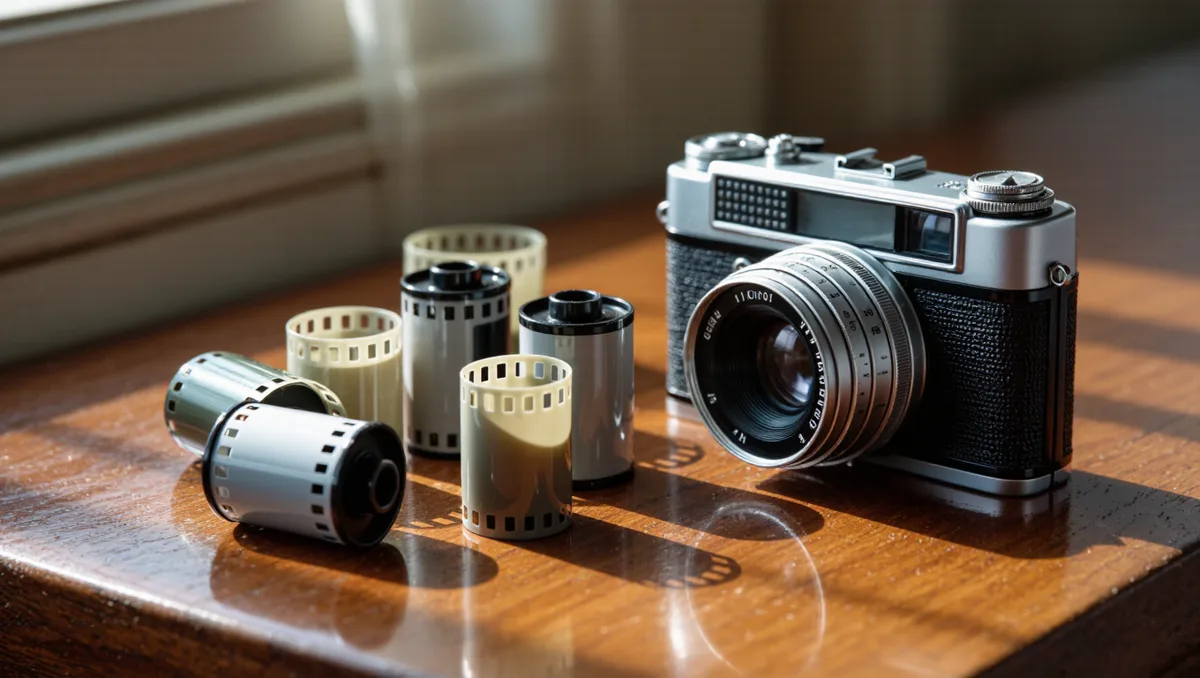
If pocketability is the requirement, almost nothing beats it. This Olympus XA pocket camera guide makes the case that the smallest true rangefinder of the film era still earns its jacket space, with one service caveat. Olympus's 1979 product literature listed the XA at 225 grams, designed under Yoshihisa Maitani as a camera meant to be always carried.
What made the Olympus XA special in 1979?
The XA is a sliding-clamshell rangefinder: the protective cover drops over the lens and controls, and the camera becomes a smooth metal slab about the size of a cigarette packet. Inside sits a fixed 35mm f/2.8 Zuiko lens, a genuinely coupled rangefinder for focusing, and aperture-preferred automation with electronically controlled speeds from 10 seconds to 1/500, all per Olympus's period specification sheet. A small lever offers plus or minus two stops of exposure compensation, which is the entire control surface, and that deliberate minimalism was Maitani's design brief made physical.
Two things set the XA apart from the compacts around it, then and since. First, it focuses through a real rangefinder patch rather than zone guessing or early autofocus, so precision at f/2.8 is achievable. Second, the electromagnetic shutter release is almost silent, which made the camera a quiet-documentary favorite. The trade is that the shutter needs battery power to fire at all; this is not a mechanical backup machine.
Design-first cameras like the XA belong in any serious study of photographic industrial design, and the historic camera collections at the Smithsonian's National Museum of American History place the pocket-camera branch of that story in context.
What should you check before buying a used XA?
Small cameras were carried constantly, and carried cameras wear. Beyond the usual foam-seal and battery-contact inspection, XAs have one model-specific fault that decides everything: sticky shutter blades. Run this five-step test in order, in person if possible.
- Open the clamshell and confirm it locks firmly at both ends; loose hinges mean a hard life.
- Set the aperture to f/22 in a dim room and fire. The shutter should still close promptly. A slow, reluctant click indicates oil on the electromagnetic shutter blades, the XA's signature fault.
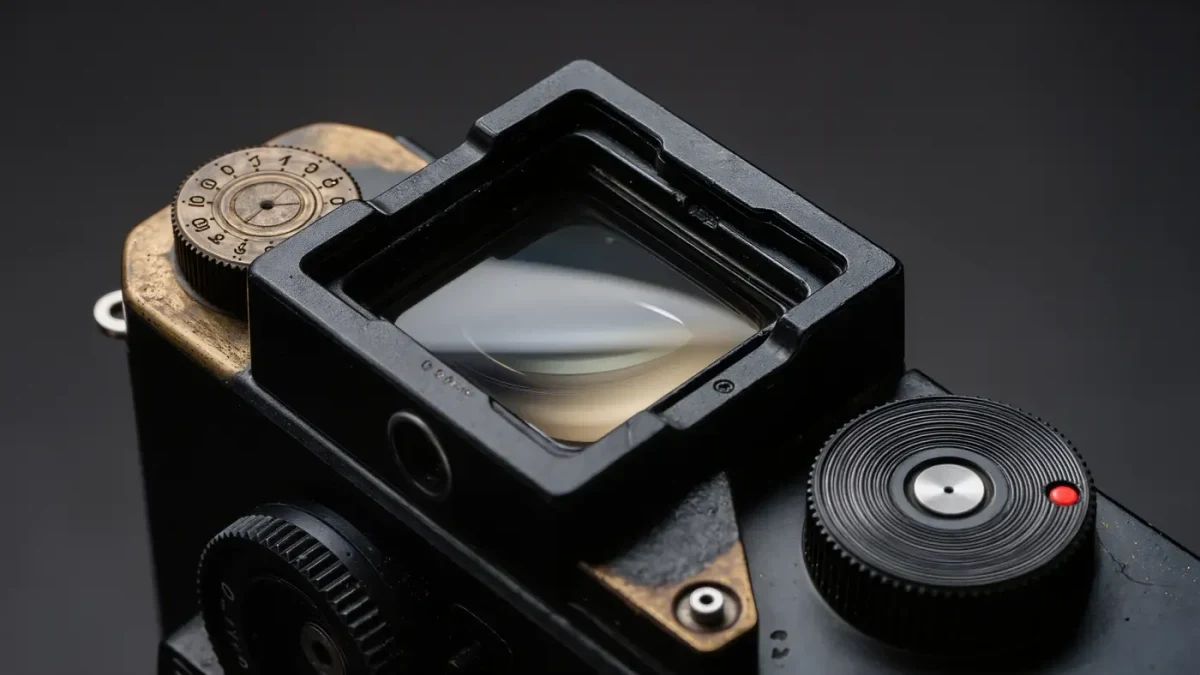
- Check the rangefinder patch for contrast and align it on a distant high-contrast edge; a dim or doubled patch makes precise focus impossible.
- Press the battery check and watch the finder LEDs; erratic indication usually means corroded contacts before anything worse.
- Slide the focusing lever across its full range, feeling for grit, and confirm the aperture detents click cleanly from f/2.8 to f/22.
The sticky-shutter test deserves the most weight because a body that fails it needs proper cleaning, not a workaround. Repair is possible; several technicians still service the XA, and a cleaned example is a joy. But the discount you negotiate should reflect the work needed, not the seller's assurance that it fired once on the desk.
Where does the XA show its age?
The finder is tiny, and glasses wearers will squint at the brightline frame. The camera never displays the shutter speed it chose, so you learn to trust the meter or bracket with the compensation lever. The dedicated A11 flash units that complete the classic kit are themselves aging electronics with failing capacitors, so treat them as optional rather than essential.
More fundamentally, everything depends on those two button cells: no battery, no photograph. For a pocket camera used near shops and spares, that is acceptable. For remote travel, carry a full spare set in the camera case, because the XA gives no warning, only silence.
Who should carry an Olympus XA?
Travelers, walkers, and street shooters who want full-frame negatives from something that vanishes into a pocket, plus medium-format shooters who want a credible 35mm backup without carrying a second system. The 35mm f/2.8 focal length suits almost everything that happens at arm's length, and the silence opens doors that clunky shutters close.
As of 2025, working XA bodies commonly run $80-200 on the used market, with clean, recently serviced examples at the top of that band and sticky-shutter bodies marketed hopefully at the bottom. Prices have crept upward as the compact-camera revival continues, so condition-checked examples are worth pursuing quickly when they appear.
One comparison worth making before buying: against a phone, the XA loses on convenience and wins on negative size, and honest buyers know which of those they are shopping for. Frame it as a deliberate choice of film's look in a pocketable form and the camera makes complete sense; buy it hoping for digital speed and it will disappoint twice, once at the lab and once at the scanner.
What is the XA like to live with?
Day to day, the XA rewards a particular discipline: aperture set to f/8 in mixed light, the compensation lever nudged for backlit subjects, and the rangefinder patch checked only when the subject stands close. The clamshell protects everything, so the camera survives keys and coins in the same pocket, which is the entire point of carrying it. Loading is fiddly in the traditional small-camera way; the film gate is tiny and the take-up spool demands patience the first few times. Form the habit of checking that compensation lever before each outing, because a pocket nudges it silently and the camera offers no other warning, and fit fresh button cells before the first roll with the spare set carried in the same pocket as the camera, not in a bag two rooms away.
The flash question comes up often. The dedicated A11 unit clips on and works automatically at one aperture, but its capacitors and selector switches are forty-plus years old, so buy one as an experiment, not a plan. Ambient-light shooting suits the camera better anyway: the little Zuiko performs beautifully at f/5.6 and f/8, and the near-silent shutter lets you take frames that a louder camera would have ended before they began.
Servicing economics deserve one honest paragraph: a clean-and-adjust for an XA typically runs $80-150 as of 2025, real money against a camera worth $80-200, so the calculation only favors cameras in genuinely clean condition that you intend to keep. That arithmetic pushes sensible buyers toward the best example available rather than the cheapest project, a reversal of the usual advice for big SLR systems where donor bodies are thick on the ground.
Is the Olympus XA still worth buying?
Yes, if the sticky-shutter test passes or the price assumes a service. Nothing else this small offers a coupled rangefinder, a real Zeiss-grade lens of its era, aperture control, and near-silence in one slab. Test before paying, budget for a clean if the blades drag, and the XA will justify the pocket space it asks for, which is very little.