Buying a used film camera comes down to four checks: the light seals, the shutter, the meter, and the price. Run all four before money changes hands and the odds swing your way. Skip one, and the cheap body quietly becomes a repair bill.
This guide walks through each check in order, in plain language, with the mistakes buyers most often make. No camera is perfect at forty years old. The goal is not a flawless machine. It is a body whose flaws you know about on day one.
Why patience beats enthusiasm at the counter
Film gear is everywhere now, but the places selling it keep changing. Even big-box retail has thinned out: the Best Buy store in Elyria, Ohio, for example, has closed, according to Best Buy's own store page, which now directs customers to shop online or at nearby locations. When the local counter disappears, more buying happens sight unseen — and sight-unseen is where buyers get burned.
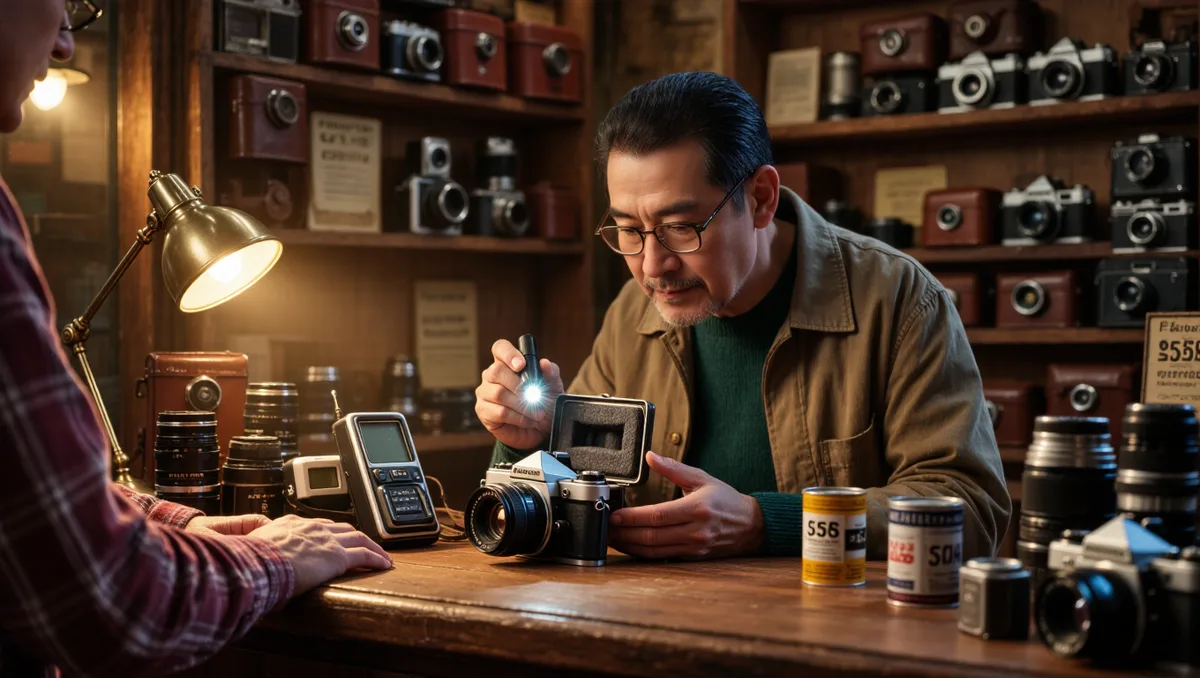
So the first rule costs nothing: inspect in person whenever you can. Hold the camera. Wind it. Fire the shutter at every speed and listen. A seller who refuses a basic inspection is telling you something before you open your wallet.
If the deal only exists online, the checklist below still applies. It just becomes a list of questions to ask, with the expectation of photos and honest answers for each one.
What do the light seals tell you?
Light seals are the foam strips that line the film door and the mirror box. They keep stray light off the film. Foam ages. It crumbles into sticky black crumbs that glue themselves to the film edge, and it stops sealing altogether.
Open the back and look at the door groove and the hinge side. Run a fingertip along the foam. Sound foam feels soft but whole. Deteriorated foam feels gummy, flaky, or is simply gone, leaving bare metal channels. Check the mirror bumper too, on SLRs — the pad the mirror slaps against. When it turns to mush, it can foul the mirror and throw off focus.
The good news: foam is one of the cheapest fixes in film photography. Seal kits exist for most popular bodies, and a careful hand can fit them at a kitchen table. But price the fix before you buy. A camera priced as working, with dead seals, is not a bargain. A camera priced honestly as needing seals can be. This connects to our earlier piece, 10 Film Cameras Beginners Should Consider Before Overspending.
How do you test a used shutter?
The shutter is the heart of the deal, and it is the part most likely to need a technician. Test it methodically.
Set the slowest speeds first — one second, half, quarter — and count along or use a phone's stopwatch. Slow speeds that hang or drag suggest the mechanism needs a service. Then fire the fast speeds and listen. You should hear a clear difference between them: a crisp snap versus a longer sweep. If every speed sounds identical, the high speeds may be stuck together.
Watch the shutter curtain or blades through the open back against a bright window. On a focal-plane SLR, the curtain should travel cleanly, without hesitation or a visible tear. On leaf-shutter cameras, the blades should open and close without sticking. Fire the shutter at one second and look through the back: you should see a full, even rectangle of light.
Two more shutter-adjacent checks. First, film advance: it should wind smoothly and cock the shutter with even resistance, and the frame counter should move. Second, if the camera has multiple exposure or self-timer modes, try them. Stuck timers are a classic hidden fault.
Does the light meter still tell the truth?
Many used meters run on battery types that are no longer made, and some meters have drifted over the decades. Neither problem kills the deal, but both change how you shoot.
Test the meter against a known reference. A phone light-meter app, a handheld meter you trust, or a modern digital camera all work as references. Point everything at the same evenly lit surface and compare readings. A meter off by a consistent amount is usable — you simply set the film speed dial to compensate. A meter that wanders or reads wildly is a different story.
If the meter is dead or unreliable, the camera can still be a fine shooter. Sunny-16 estimation and an external meter carry plenty of photographers, and our guide to metering and darkroom craft covers reading light without a battery. But a dead meter should be priced into the purchase, not discovered after it ruins a roll. Ask the seller directly whether the meter responds, and what battery the camera takes — some old meters need hard-to-find cells or an adapter.
What else deserves a look before you pay?
Beyond the big four, a short sweep catches most remaining surprises.
- Lens condition. Look through the lens at a bright light at wide aperture. A little dust is normal and harmless. Haze, fungus (fine web-like threads), or a scratched element are not. Fungus spreads and eats coatings. Check that focus and aperture rings turn smoothly, and that the aperture blades snap clean and oil-free — oily blades stick.
- Battery compartment. Open it. Corrosion from an old leaked cell can eat traces and kill electronics. Green or white crust is a walk-away sign on an electronic camera unless the price reflects a repair.
- Frame spacing and film transport. If the seller allows, load a sacrificial roll or check that the take-up spool engages. Uneven frame spacing points at transport trouble.
- Cosmetics and completeness. Missing lens caps, straps, or backs matter less than function, but originals affect value and usability. Dents on a rangefinder or TLR can mean a knock that bent something internal.
- Authenticity. Popular models get faked and frankensteined — parts cameras dressed up as complete ones. Our guide to spotting fake vintage cameras covers the tells in detail.
Ask for the camera's history when you can: one owner beats five, storage in a dry closet beats a damp attic, and a recent service with paperwork beats a mystery.
What is a fair price for a used film camera?
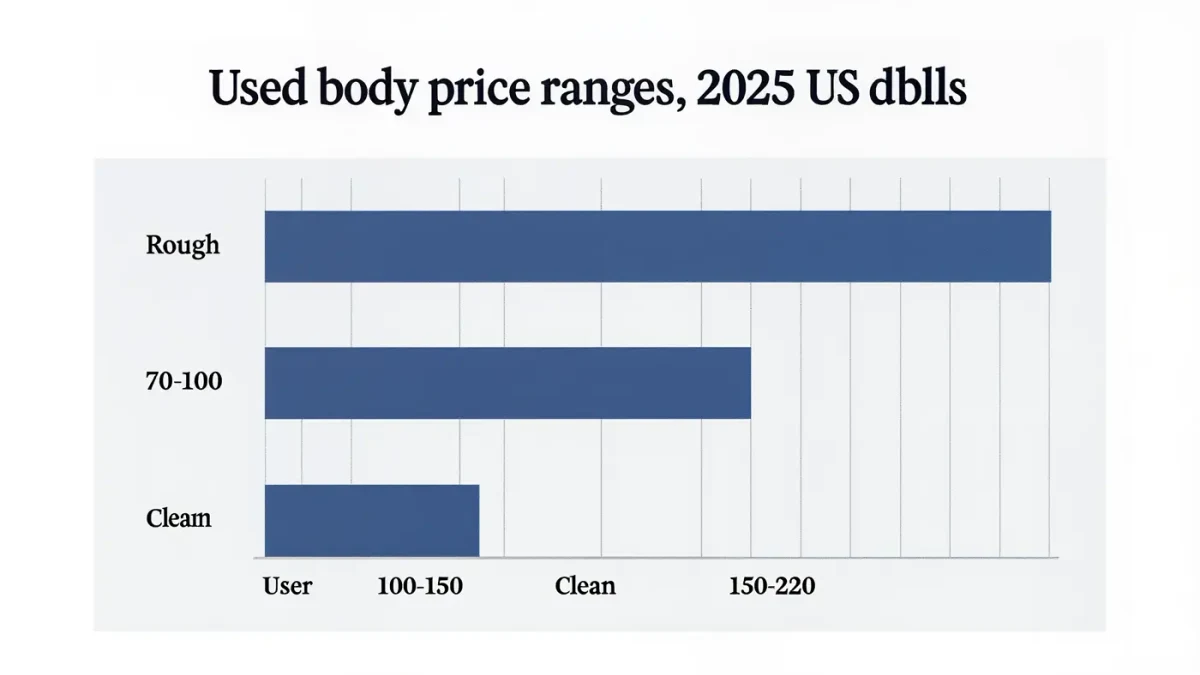
Fair price is a range, not a number, and it moves with condition and demand. Our analysis of the market comes down to three inputs: what the same model has recently sold for, what the body needs, and what a service would cost if it needs one.
Check completed sales on the big auction and marketplace platforms rather than asking prices — asking prices are wishes, sold prices are facts. Then price the faults. Dead seals, a sticky shutter, a drifting meter, fungus in the lens: each one is either a bargaining chip or a reason to walk. A repair quote from a camera technician is your best negotiating tool and your best reality check. If the repair quote plus the asking price exceeds the cost of a known-good example, the deal is not a deal.
Beware the hype tax on fashionable models. Compact point-and-shoots and certain rangefinders carry prices far above their mechanical worth because of demand, not quality. Our Contax T2 guide looks at one such case, and our roundup of film cameras for beginners lists bodies that deliver more camera per unit of money. If you are choosing a first body at all, our beginner's guide to choosing a first film camera pairs well with this checklist. Readers following this should also see Spotting Fake Vintage Cameras: A Buyer's Guide.
What this means: a five-minute ritual
Condense all of this into a routine you can run in five minutes at any market stall or shop counter.
- Open the back. Check the foam with a fingertip.
- Wind and fire the shutter at slow speeds, then fast ones. Listen for differences.
- Look through the open back at one second against a light.
- Compare the meter to a reference, or confirm it is dead and price that in.
- Inspect the lens for haze and fungus, and the battery bay for corrosion.
- Then, and only then, talk about price.
None of this requires expertise. It requires slowing down at the exact moment excitement tells you to speed up. The sellers who object to a five-minute inspection are rare, and the ones who welcome it are usually the ones with honest cameras. That, more than any single spec, is the tell of a purchase you will not regret.