When fixer vanishes from supplier shelves, the cause is usually allocation rather than accident: photo chemistry is a rounding error in the global chemical industry, its inputs made in reactors sized for pharmaceutical and polymer customers. Silver nitrate rode silver past $50 an ounce in October 2025, per Reuters — the metal's first time above that mark since 1980.
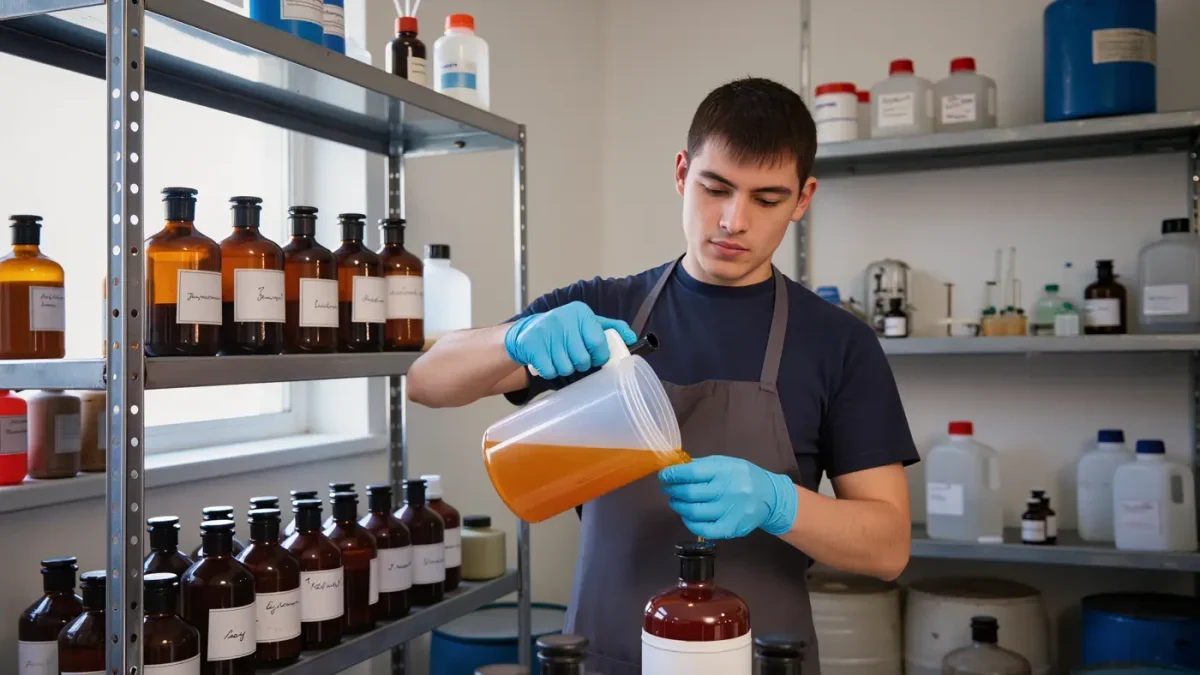
Photo chemistry looks like a specialty product, but it is mostly commodity chemicals repackaged. Black-and-white developer is a handful of organic reducing agents — metol, hydroquinone, phenidone, ascorbic acid — plus sulfite preservative and borate or carbonate alkali. Stop bath is dilute acetic acid. Fixer is sodium or ammonium thiosulfate. Color processes add the exotic-sounding but industrially standard paraphenylenediamine developing agents (CD-3, CD-4), bleach-fix chemistry and stabilizers. Every one of these is made in plants whose primary customers are orders of magnitude larger than the entire photo-hobby market.
What is photo chemistry made of?
The blend matters less than the sourcing. A powder developer's active ingredients come from fine-chemical producers who sell to labs, mining companies and water-treatment firms; a liter of concentrated fixer begins as a bulk thiosulfate shipment. Photo-chemical brands — Harman's Ilford line, Adox, Bellini in Italy, the Fujifilm-descended lines, CineStill's rebranded kits — are, to a first approximation, blenders and bottlers sitting on top of that commodity base. That is not a criticism; it is the structural fact that explains the shortages.
What actually ran out, and when?
The revival's first stress test came before anyone planned for it. Through 2020 and deep into 2021, standard black-and-white developers — the D-76 and ID-11 class — were out of stock at major US and European retailers for months at a stretch, alongside selected fixers and C-41 kit components. Nothing had broken; a demand lump had simply met a lean chain. Later pinch points were narrower but repeated the pattern: one-gallon C-41 kits disappearing between restocks, E-6 chemistry thinning when slide-film enthusiasm outran blender forecasts, and regional gaps that persisted because hazmat freight made it uneconomical to move surplus stock across borders. Each episode resolved the same way — a few months of patience, then shelves refill — which is precisely what a commodity-supply hiccup looks like from the outside.
Why does photo demand lose priority?
Reactors run campaigns. When a plant schedules a batch of hydroquinone-grade intermediate, the buyer ordering a tonne for polymer inhibitors gets the slot; the photo-chemical blender needing 200 kilograms waits for the next window. Minimum order quantities then force blenders to hold inventory, but shelf life limits how much: liquid concentrates oxidize in months once opened, and even sealed stock ages. So the industry runs deliberately lean — and when a reactor goes down, a formulator switches suppliers, or demand lumps, the lean chain snaps and retail shelves empty in weeks.
What did the Tetenal shock reveal?
The clearest single-firm lesson came in December 2020, when Tetenal — founded in 1848, for two centuries Germany's photo-chemistry house — filed for insolvency. The filing disrupted European blending, bottling and distribution while operations continued under restructuring, and competitors spent months absorbing demand. What it exposed was concentration: the number of firms able to blend to photo tolerances, package in consumer volumes, and ship hazardous goods internationally can be counted on two hands. When one stumbles, there is no deep bench.
Why is shipping half the battle?
Photo chemistry is hazardous goods by classification: corrosive concentrates, oxidizers, and volatiles that regulators restrict in air and ocean freight. Hazmat surcharges, limited carrier acceptance and cross-border paperwork make a case of bottles cost as much to move as to make. Winter adds freeze risk for water-based concentrates, effectively pausing economical shipping to cold regions for months. The result is regional scarcity that has nothing to do with manufacturing: a product can be abundant in Germany and absent in Canada simultaneously.
Packaging is the unglamorous second bottleneck. Consumer photo chemistry sells in one-liter and smaller bottles with specific closure types, and a shortage of suitably rated containers or fitments can idle a blending line that has product ready to ship. Bottles are ordered in bulk from packaging industry suppliers — another place where photo demand is a rounding error — and blenders who skipped a packaging order cycle find themselves with tanks of finished fixer and nothing compliant to put it in.
How should a darkroom read a shortage?
Practically, with patience and rotation. Powders outlast liquids by years — a sealed powder developer is good long after its liquid sibling has turned brown; fixer crystals keep almost indefinitely. A sensible shelf holds one staple developer mixed from powder, one working fixer tested with a leader strip, and reusable stop bath, rather than five half-empty boutique bottles. Shooters who also mix from raw chemicals — sodium sulfite, metol, thiosulfate are sold by chemical suppliers outside photo channels — have a fallback the branded market cannot strand, and a bag of each keeps a darkroom alive through any brand's gap.
The deeper takeaway is about the industry's shape. Photo chemistry survives as a beloved niche on top of supply chains that do not need it. That is why availability will always be lumpy, why discontinuations follow quietly when a raw input loses its other customers, and why the most durable preparation is not hoarding but knowing what is actually inside the bottles — because those contents come from somewhere much bigger than photography, and that somewhere sets the schedule.