A typical US photo lab charged $12-18 for develop-and-scan in 2025, and roughly $1-3 of that bought chemistry; the rest paid technicians, machines, rent and shipping. The film revival moved the industry's scarcity from customers to capacity — and unit economics, not nostalgia, decided which labs scaled and which quietly closed.
Labs are service businesses wearing a hobby's clothes. Their costs are dominated by labor hours per roll, aging machinery that nobody manufactures at scale anymore, and — for the mail-order operations that now handle much of the country's volume — two-way freight. The chemistry, the part shooters scrutinize, is the cheapest line on the invoice.
Where does the lab's fee actually go?
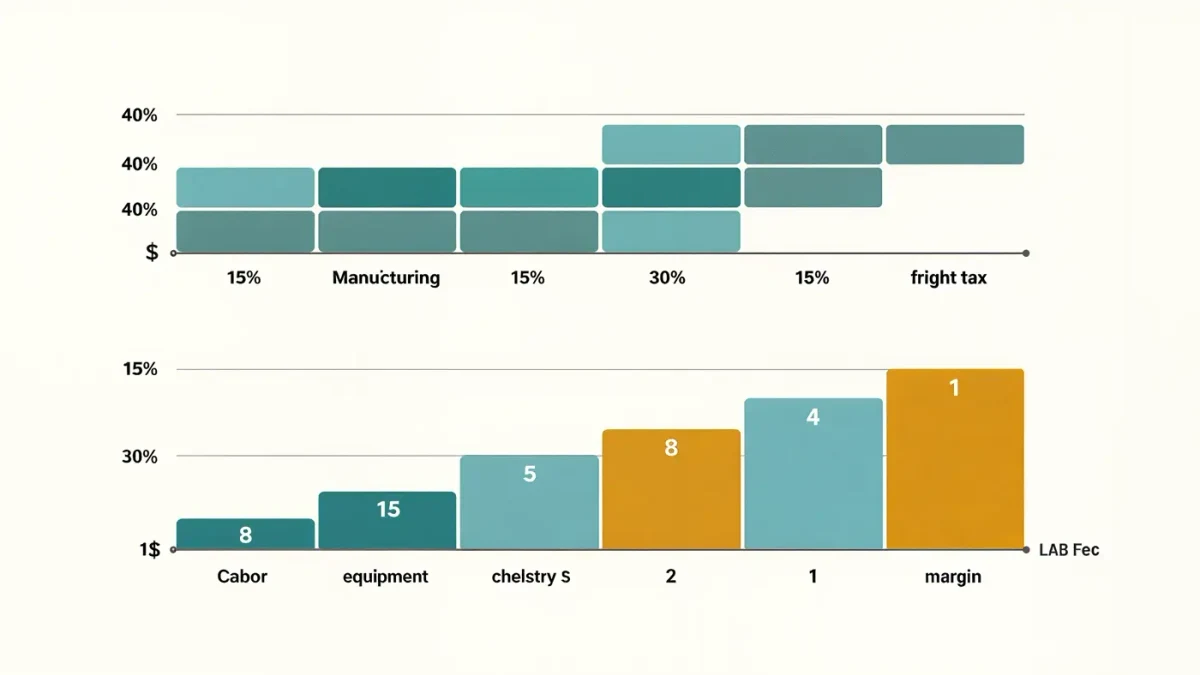
An illustrative split of a $15 develop-and-scan, rounded from industry-typical practice as of 2025, looks like this: chemistry and film handling consumables $1-3; technician time for loading, processing, inspecting and scanning $4-7; equipment amortization and maintenance $1-3; rent, utilities, software and insurance $2-4; and margin $1-3 before the owner pays themselves. The Bureau of Labor Statistics tracks photofinishing inside its producer price data, and the service's pricing history tracks exactly these components, not silver or paper alone.
Two structural facts follow. First, volume is everything: the second hundred rolls of a day ride the same staffed machines as the first fifty, so margins improve sharply with utilization. Second, scanning — not developing — sets the throughput ceiling, because automated scanner fronts process one strip at a time under an operator's eye. This is why scan tiers, not process tiers, are where menus differentiate: the $5 difference between standard and premium files is nearly pure margin once the roll is already in the machine, priced against the one truly scarce resource, scanner-minutes.
Could someone open a new lab in 2025?
Yes, and people did — but the startup math explains why most new entrants are small studios with a tabletop processor rather than full mini-labs. A realistic opening stack runs roughly $50,000-150,000: a rebuilt processor and scanner, plumbing and ventilation build-out, chemistry stock, temperature-stable storage and software. At a $3-5 contribution margin per standard roll after variable costs, the machine pays for itself only through hundreds of rolls per week, sustained for years. That is why the wave of new openings through the revival clustered in cities with university density and photography programs, and why so many of them lean on mail order from day one — the local walk-in trade alone rarely fills the machine.
The staffing constraint binds hardest. A processor can be taught in weeks; a scanner operator who can color-manage a faded 1985 negative without rescans takes a season. Until 2021 most labs overstaffed against declining volume; after 2021 almost none could hire fast enough, and wages for experienced technicians rose accordingly — one more line item pushing that $12-18 menu price, and one more reason the survivors guard their trained people carefully.
What happened to the corner mini-lab?
The economics above explain a disappearance that predated the revival. Drugstore and grocery mini-labs ran on volume in the hundreds of rolls daily; when digital cut that to dozens, each surviving roll carried the full fixed cost of a machine, a lease and a part-time operator, and the units vanished through the 2010s. What remained was a barbell: central mail-order factories on one end, boutique pro labs on the other. The revival refilled both — but it could not resurrect the middle, because a $60,000 machine cannot breakeven on thirty rolls a day at any price a neighborhood would pay.
What does the equipment cost?
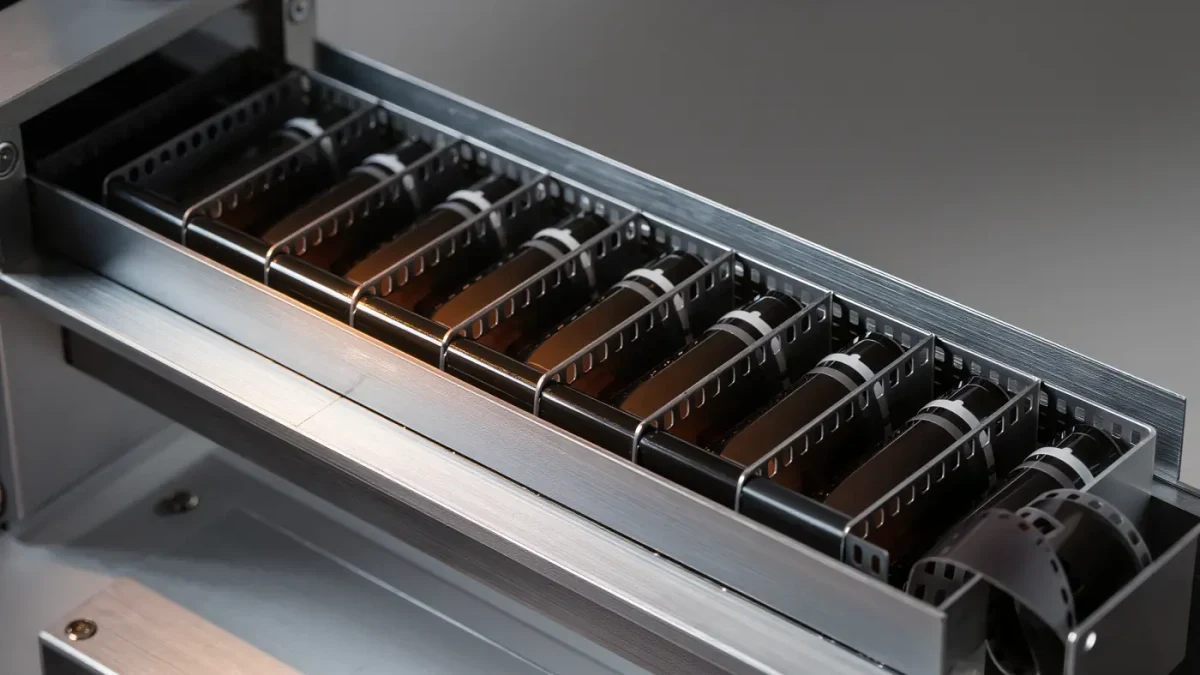
The revival runs on machines built for a larger industry. Professional mini-labs — the Noritsu and Fuji Frontier lines that dominate US labs — are no longer produced in volume, so the market is secondhand: rebuilt systems traded roughly $20,000-80,000 as of 2025, condition-dependent, with scanner fronts holding value best because they are the irreplaceable part. A C-41 processor can be a compact tabletop unit for a small shop or a dip-and-dunk line for a pro lab; E-6 lines are rare enough that slide film routes to specialists by mail. The long-run budget risk is not purchase price but parts: boards, lasers and drive assemblies for orphaned machines, sourced from a shrinking pool of technicians who know them.
Why did wait times stretch?
Between 2020 and 2022, roll volume surged while labs were running skeleton crews, and queues of several weeks became normal. The bottleneck was rarely chemistry — it was scanner hours and trained hands. Backlogs eased through 2023-2025 as labs added shifts and equipment, but capacity stayed tight because the fix is lumpy: a lab cannot buy half a Frontier, and a new hire trains for months before touching a customer's negatives alone. Labs that invested in that period now run with healthier utilization; labs that couldn't finance a machine upgrade priced themselves into a corner.
How do mail-order labs make money?
Centralization is the model. A national mail-order lab processing hundreds of rolls a day earns manufacturing-style utilization from service equipment: freight is batched, chemistry is replenished in volume, and every roll passes the same scanner line. Pricing nudges efficiency — prepaid multipacks, subscriptions, tiered scan resolutions where the standard scan is cheap and the premium files carry real margin. Round-trip shipping runs $8-12, which is why mail orders cluster: nobody mails one roll.
The walk-in neighborhood lab lives on different math — rent and foot traffic, disposable cameras, passport-style services and prints — and survives by being the only game in a zip code. Both models price the same $12-18 headline service; their cost structures are entirely different animals.
Which services actually pay the bills?
- Develop-and-scan volume — the anchor product; low margin per roll, healthy in aggregate.
- Premium scans — higher resolution and hand correction add $5-15 per roll of mostly labor-priced margin.
- E-6 and medium format — scarcer capability priced at $15-25 and above, as of 2025 rounded menus.
- Prints and products — the original upsell, returning as shooters want objects again.
- Business accounts — schools, studios and agencies with steady volume and invoiced simplicity.
The vulnerable lab is the single-machine shop whose owner is the technician: one breakdown from closure, one quiet month from retreat. The resilient ones own redundancy — two processors, two scanners, cross-trained staff — because in this business, uptime is the product behind every price tag on the menu board.