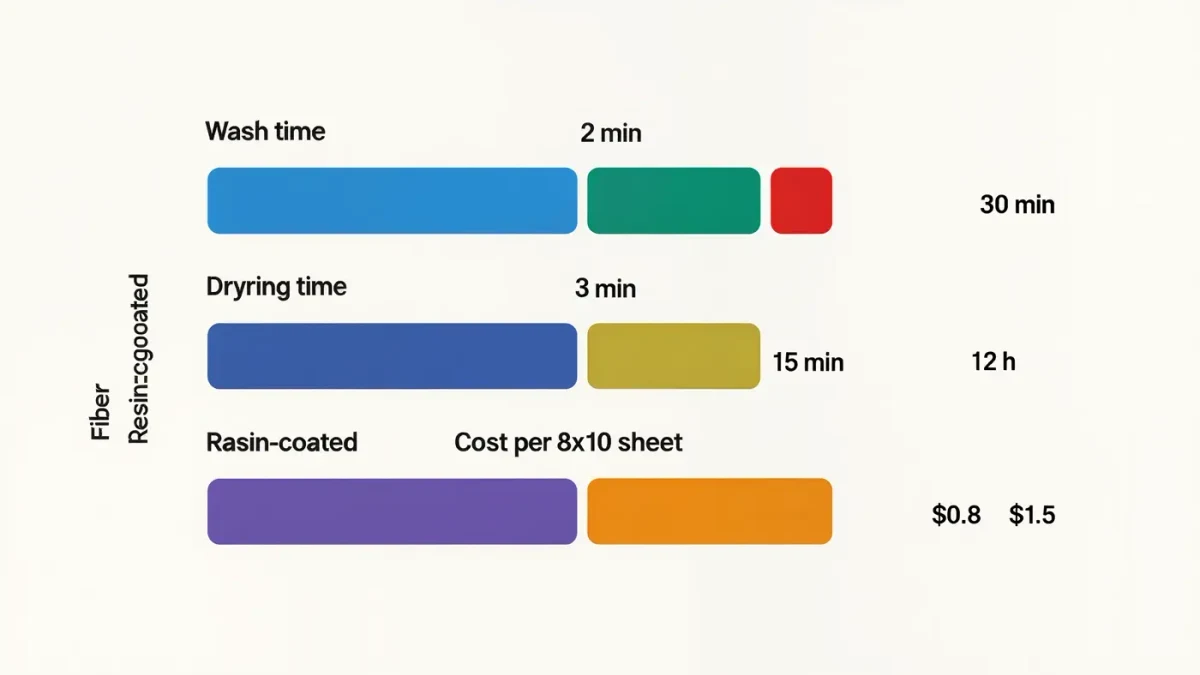
Fiber vs resin printing paper is a choice about base material, and the base decides the workflow. Per Ilford's datasheets, Multigrade RC paper washes clean in about 2 minutes, while fiber-base Multigrade needs roughly 30 minutes of washing for archival keeping (Ilford, as of 2024). As of 2025, an 8x10 sheet runs roughly $0.60-1 in RC and $1-2 in fiber.
What is actually different about the two papers?
Resin-coated paper sandwiches a paper core inside thin polyethylene layers, so chemistry works only at the surface and never soaks the base. Fiber paper is cellulose through and through, with a baryta layer under the emulsion — solutions penetrate the whole sheet, which is why every stage takes longer and dries richer.
| Stage | Resin-coated (RC) | Fiber base (FB) |
|---|---|---|
| Develop | about 60 seconds | 60-90 seconds |
| Fix | 30-60 seconds, single bath | two baths, about 2 minutes each |
| Wash | about 2 minutes | 30-60 minutes with wash aid |
| Air dry | 10-20 minutes | overnight |
| Finish | flat as dried | needs pressing or mounting |
The emulsions themselves are close cousins — Multigrade RC and Multigrade FB share a look and respond to the same filters. What changes is everything the emulsion sits on. darkroom coverage.
Weight tells the story blind: an 8x10 RC sheet feels like card stock, fiber like thin board, and the difference in the hand is the difference in the wash. Neither is a counterfeit of the other — they are different products that happen to share an emulsion family.
Which paper should you print on?
Resin-coated for everything fast, fiber for everything final. RC's short wash suits proofing whole rolls and learning printing at low cost per sheet; fiber rewards the chosen images with deeper blacks, richer toning, and archival keeping measured in generations. Most printers who stay in the darkroom end up running both.
- Choose RC for contact sheets, work prints, portfolio boxes handled often, and every learning session where volume beats luxury.
- Choose fiber for exhibition prints, anything destined for selenium toning, and images meant to outlive their maker.
- Budget accordingly: as of 2025, RC costs roughly $0.60-1 per 8x10 sheet against $1-2 for fiber — proof generously on RC, print sparingly on fiber.
Hybrid workflows are common and sensible: print the edition's working proofs on RC, then match the final fiber print to the approved proof. Because the emulsions are closely related, filter packs and exposure times carry over with only small corrections — the fiber version usually wants a breath more time.
How does washing differ?
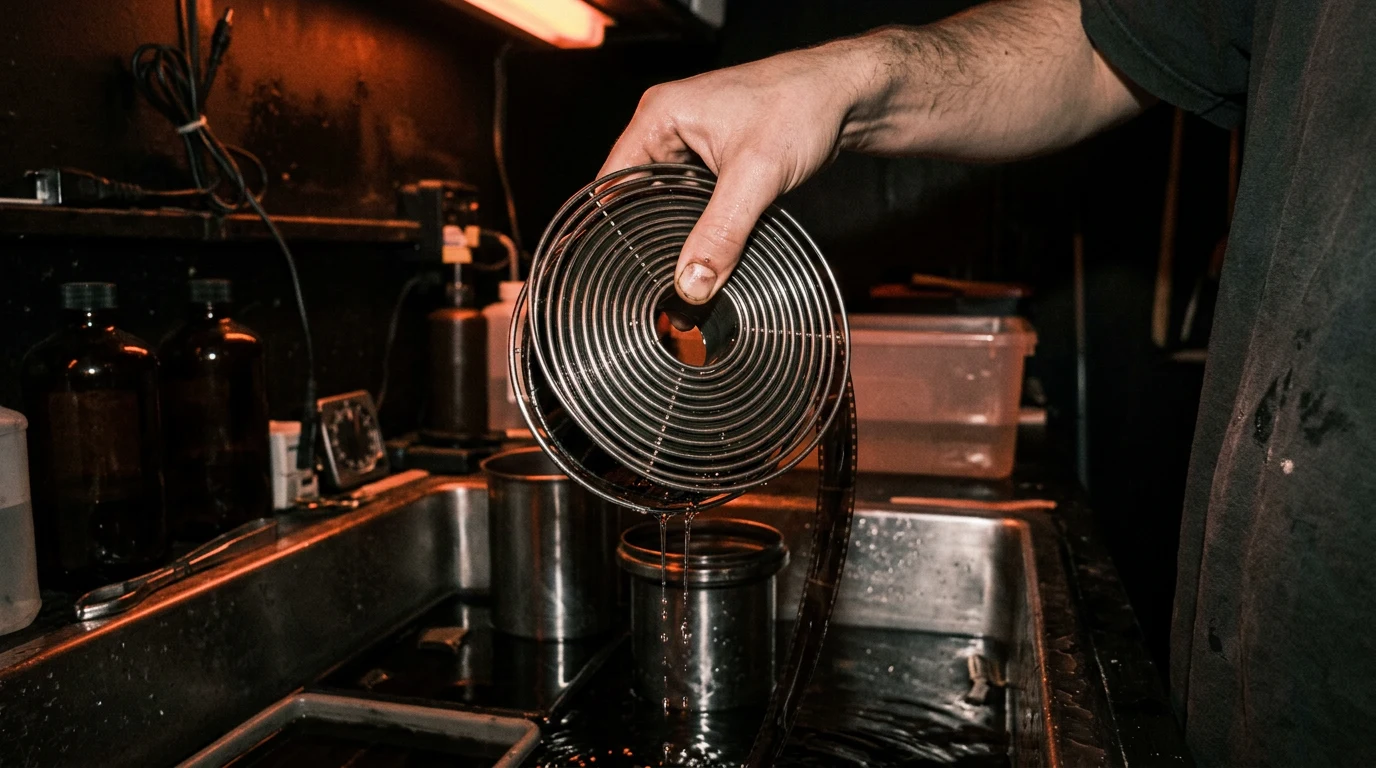
More than any other stage. Resin-coated paper is washed in about two minutes because residual chemistry sits near the surface; fiber's soaked-in fixer needs roughly half an hour, helped by a wash aid that swaps fixer complexes out of the fibers. Washing is where the archivality of fiber is actually earned.
- Fix fiber prints in two fresh baths rather than one long soak — the second bath stays nearly uncontaminated.
- Rinse briefly, then immerse prints in a wash aid for the time the aid's instructions specify.
- Wash in running water or an archival washer for 30-60 minutes, keeping prints separated so water moves between sheets.
- For RC, a two-minute wash in running water is the whole stage — longer soaks buy nothing.
Wash efficiency depends on water movement, not volume: a trickle through a proper print washer outperforms a flood in a static tray, where prints shield each other and the water nearest each surface never changes. Keep sheets separated and the water moving, and the clock does the rest.
Why does fiber paper dry curly, and what can you do?
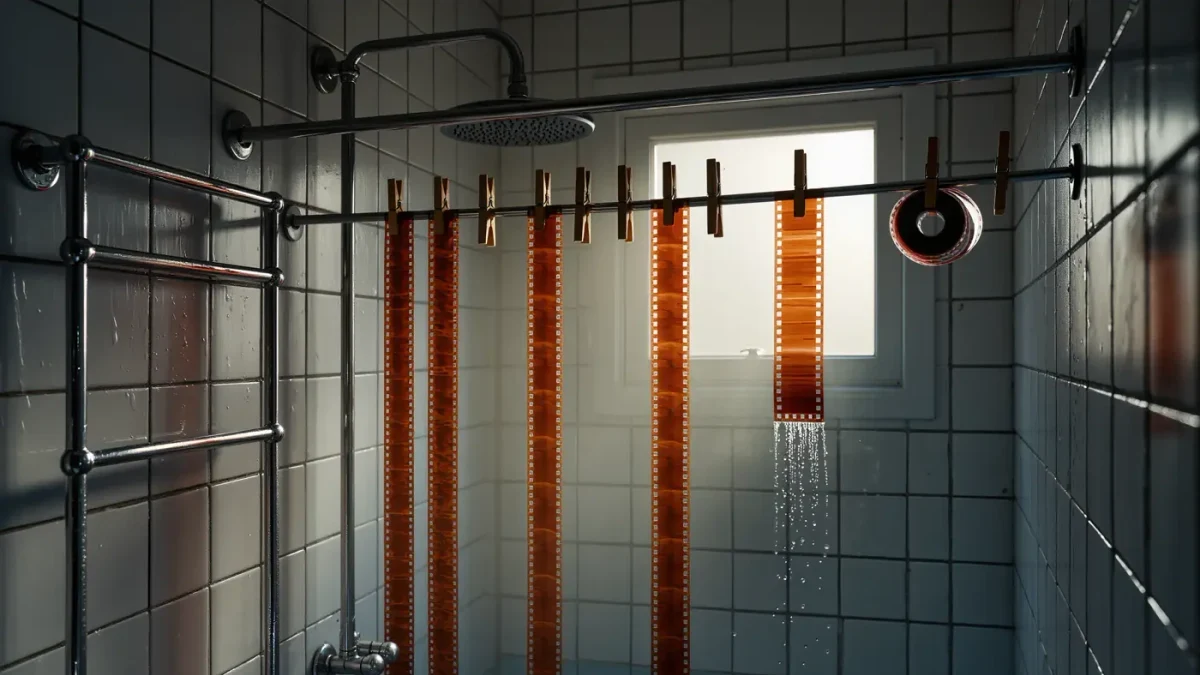
Because wet cellulose shrinks as it dries, and it shrinks unevenly across the sheet. The emulsion side contracts differently from the back, and the print cups toward whichever face lost more water. Flatten by drying face-up on screens, then pressing the fully dry stack under weight or in a dry-mount press.
- Air dry fiber prints face-up on mesh screens, never hanging from clips, which pull the sheet into waves.
- Once fully dry — usually overnight — stack prints face-to-face and back-to-back between clean blotters.
- Load the stack under a heavy weight for a day, or run it through a dry-mount press at low temperature.
- Store finished fiber prints flat in archival sleeves; humidity reintroduces the curl paper fought on the way out.
RC dries flat because its plastic layers do not swell; that is a genuine workflow advantage for boxes of work prints. Fiber's curl is the price of its depth, and a modest investment in a press or mounting supplies turns the price into a one-time cost.
Does toning work on both papers?
Both tone; fiber benefits more. Selenium and other toners react with the silver image, and fiber's silver sits in a dense baryta layer that takes tone evenly and gains archival stability from the conversion. RC's image in its thin surface layers tones faster, weaker, and with less permanence payoff — usable, rarely worth it.
A classic fiber workflow ends with a brief selenium toning to a warm-brown split, which simultaneously converts the silver to a more stable compound. The same dip on RC shifts color slightly and stops there — the reason toning demonstrations in serious darkrooms happen on fiber almost exclusively.
Timing controls tone: a few minutes in diluted selenium cools and deepens blacks subtly, longer soaks push warm browns, and toning after fixing rather than before keeps the change predictable. Test with a duplicate print, because selenium's shift only fully reveals itself after drying.
What are the most common paper-choice mistakes?
Washing fiber like resin, forcing fiber flat while wet, and expecting resin prints to behave like heirlooms. Each error comes from treating the two papers as interchangeable — they share emulsions but not physics. Respect the base material and both papers do exactly what they promise.
- Washing fiber for two minutes. Residual fixer inside the base browns the print within a few years.
- Washing RC for an hour. It was finished at two minutes; the extra time only stresses the edges.
- Pressing fiber while damp. Pressure on soft gelatin glazes or cracks the emulsion surface.
- Toning RC expecting fiber depth. The shift is thin and the permanence gain thinner.
- Storing fiber loose in a humid room. Curl returns with the moisture; sleeves and dry storage keep prints flat.
Long-term care guidance for processed prints — storage materials, humidity, display — follows the same rules institutions apply, and the Library of Congress's preservation division publishes them in practical form.
The choice is not a hierarchy. Resin paper is honest, fast, and flat; fiber paper is slow, deep, and permanent. Print the contact sheet on resin tonight, and reserve fiber for the frames that deserve thirty minutes of washing and a place on the wall for fifty years.