Somewhere between the developer and the fixer sits a small step that causes big arguments in darkroom conversations: the rinse between the baths. Some photographers always use a chemical stop bath. Others just use water and see no reason to change. Both camps have a point, because the two rinses do the same job in different ways.
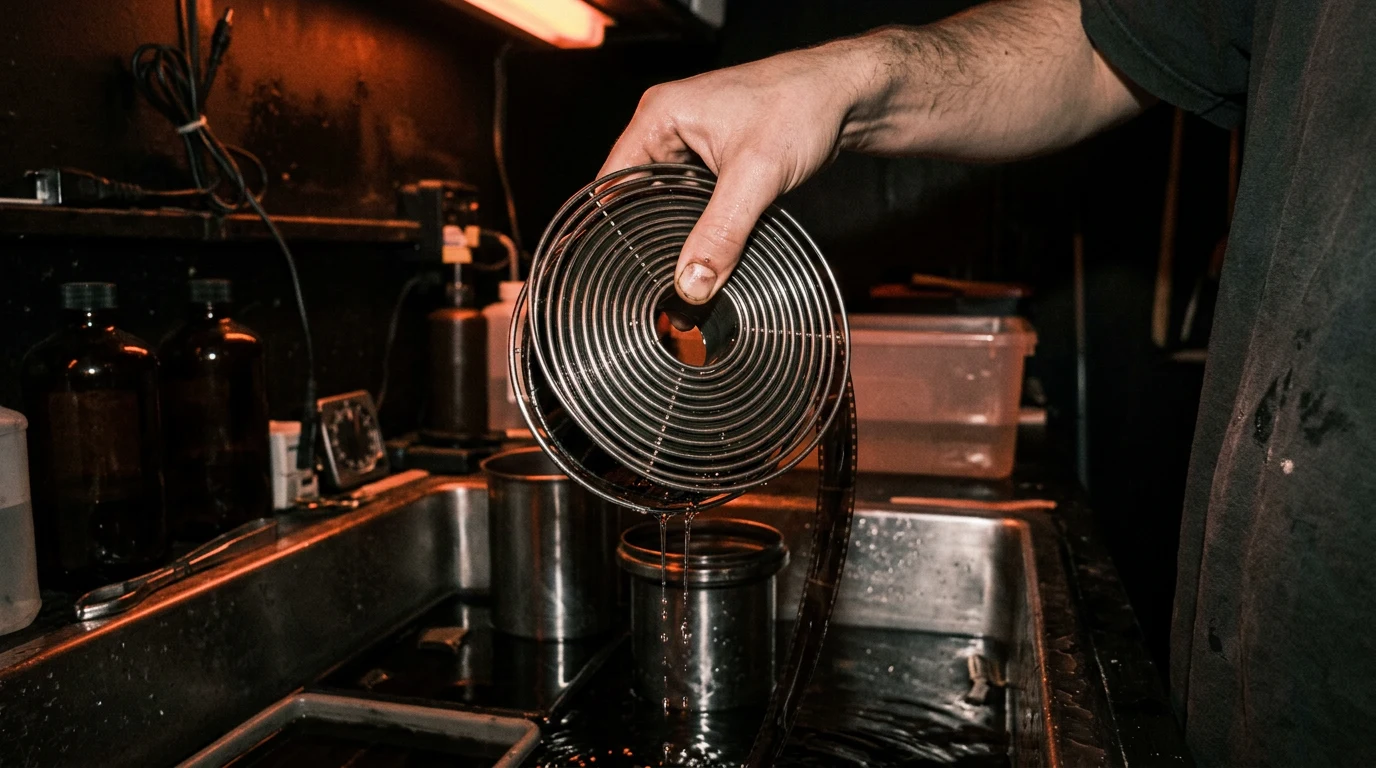
To see why, remember what the developer is doing at the moment you pull the film out. Processing turns the latent image into a visible one. It also makes that image permanent. The developer does the first part: it converts the latent image to particles of metallic silver (Wikipedia). That reaction does not stop on its own the instant the film leaves the developer. Something has to halt it.
What Stop Bath Actually Does
A stop bath is typically a dilute solution of acetic acid or citric acid, and its job is simple: it halts the action of the developer. Development is a chemical reaction. The acid ends it quickly and decisively. This matters because the whole process runs on timing. Processing requires very close control of temperature, agitation and time. Every extra second in the developer keeps building density. A fast stop protects the exposure you planned.
What a Water Rinse Does
Here is the part that surprises newer darkroom workers: a rinse with clean water may be substituted for the stop bath. Water works by dilution. It carries developer away and slows the reaction down, rather than chemically ending it. That takes longer than acid. But it still separates the developer from the fixer, which is the real point of the step.
Water also has a second role. The film may be soaked in water to swell the gelatin layer, which helps the later chemical treatments work. So plain water is not just a weaker stop bath. It is also a preparation step that softens the emulsion for what comes next.
Which One Should You Use?
For most home developing, the choice comes down to habit and control. If you want development to end at a precise second, acid gives you that hard cutoff. It also leaves less developer to carry into the next bath. If you develop now and then and like a simple shelf, water is a fully documented substitute, and it costs nothing. Whichever you pick, be consistent from roll to roll. Your development times only mean something if the steps around them stay the same. A plain water rinse may simply take a little longer before the film is ready for the fixer. For related coverage, see E-6 Home Development Guide.
The Rest of the Sequence Still Decides Everything
No rinse can rescue sloppy timing elsewhere. Keep the temperature steady, keep agitation even, and keep your times honest. After the stop comes the fixer. It makes the image permanent and light-resistant by dissolving remaining silver halide. Then comes the final wash in clean water. That wash removes any remaining fixer from the film. The stop step sits in the middle of a chain, and the chain is only as steady as its weakest link. This connects to our earlier piece, How Long Should You Wash Film Negatives After Fixing?.
Conclusion: Two Speeds of the Same Step
Stop bath and water are not rivals so much as two speeds of one step. Acid halts the developer chemically and fast. Water dilutes the developer and slows it down. It may be substituted where simplicity matters more than split-second control. Both lead to the same place. The film's development has ended, and it is ready for the fixer. Pick the one that fits your routine, use it the same way every time, and your negatives will thank you for the consistency.