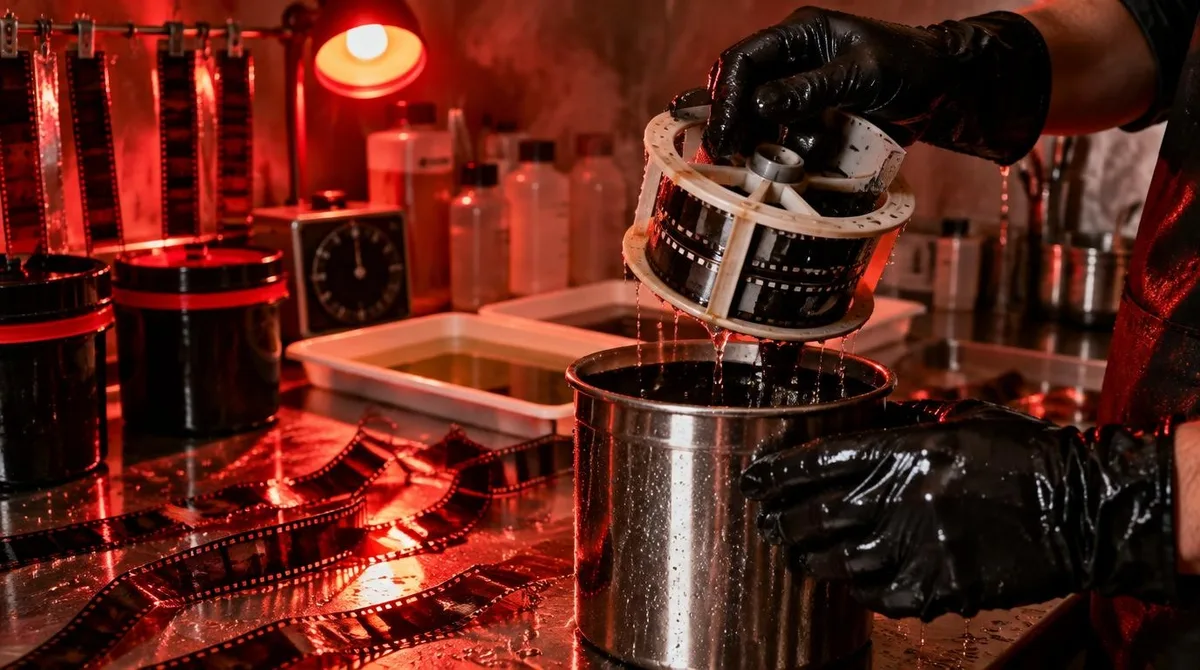
Darkroom film developing runs on three baths in a fixed order: developer, stop bath, fixer. The developer turns pale silver halides into black metallic silver, per Wikipedia's developer entry, and the stop bath that follows is commonly a 2 percent acetic acid mix, per Wikipedia's stop bath entry.
Each bath has one job, and the order never changes. Learn what each one does to the emulsion. Then the numbers on the bottle stop being a mystery. For related coverage, see Stop Bath vs Water: What Each Rinse Actually Does.
The developer makes the image
Development is reduction chemistry. The developer reduces silver halides, which are pale in color, into silver metal, which reads black in fine particles, per Wikipedia's developer entry. It acts much faster on grains that light has struck. That is how the invisible latent image turns visible. The clock is the real dial: the entry notes all the halides blacken in the end if a bath runs long, so time ends development, not the chemistry.
- Developing agents do the reducing. Metol, phenidone, and hydroquinone carry the load, per the entry.
- An alkali sets the pace. Sodium carbonate or borax raises the pH, per the entry.
- Sodium sulfite holds back oxidation. A pinch of potassium bromide restrains the mix and curbs chemical fog, per the entry.
- Mixing has an order. The entry says to dissolve chemicals in the order listed, and metol goes first.
- Formulas carry names. The entry lists Kodak's D-76 for film, D-72 for prints, and D-96 for motion picture negatives.
The stop bath calls time
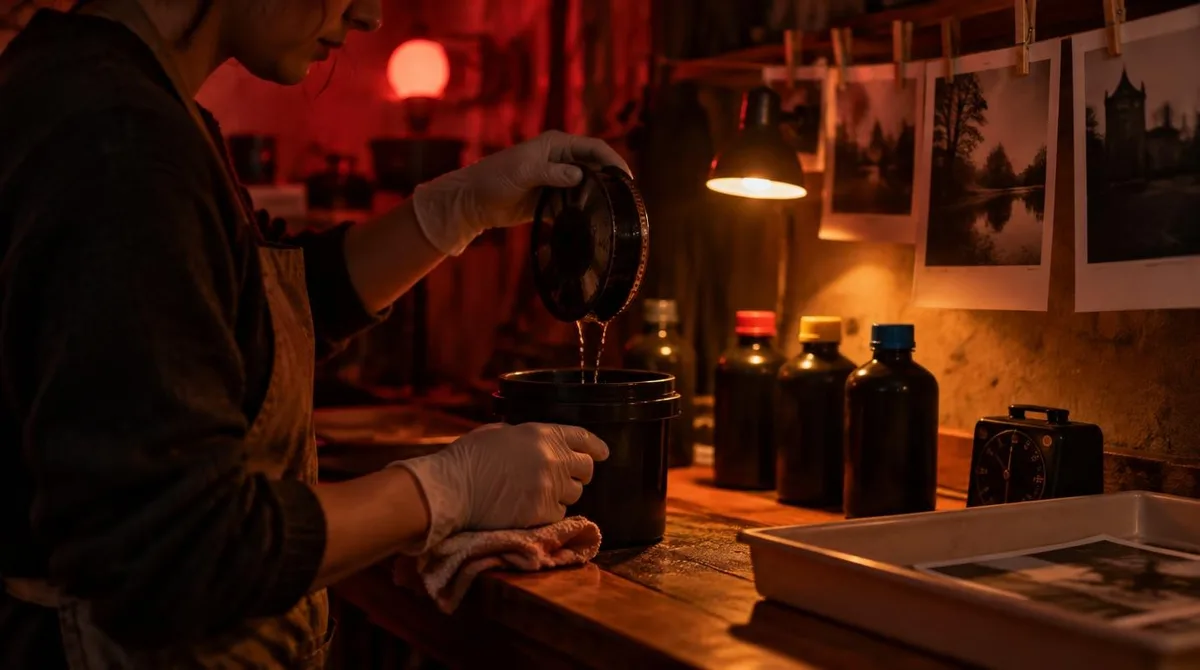
The stop bath is the referee. It is an acidic solution that neutralizes the alkaline developer and halts development, per Wikipedia's stop bath entry. The standard mix is a 2 percent dilution of acetic acid, though a 2.5 percent solution of potassium or sodium metabisulfite works just as well, per the entry. Organic developers only work in alkaline solutions. So the stop bath ends development almost at once, and timing turns exact.
It also guards the next bath. Cancelling the developer's alkali preserves the strength of the fixer, per the entry, so that bottle lasts longer. The darkroom smell is the bath at work: the entry credits stop baths with the room's vinegar-like odor, and notes the concentrate can cause chemical burns while the working mix is harmless. Indicator mixes change color when spent. The bath announces its own rest.
The fixer makes it permanent
Fixing is the step that keeps the picture. Photographic fixer removes the unexposed light-sensitive material and leaves the image safe from further light, per Wikipedia's fixer entry. The working salt is thiosulfate: sodium thiosulfate, the old hypo, or ammonium thiosulfate in modern rapid formulas, per the entry. Skip it and the leftover halides darken on their own, fogging the frame the shooter meant to keep.
Then comes water. The entry is blunt: after fixation, washing removes the exhausted chemicals, and skipped washes damage the image over time. Color work runs a variant called blix, a bleach fix of ammonium thiosulfate and ferric EDTA, per the same entry.
Mistakes the darkroom punishes
- 1. Drifting past the clock in developer. The developer entry notes all silver halides eventually reduce and turn black, so an untimed bath slides toward fog.
- 2. Handling the strong stuff loosely. The stop bath entry warns that concentrated acetic acid can burn, while the 2 percent working mix is harmless.
- 3. Rushing the wash. The fixer entry ties the image's future to washing out spent chemicals, and skipped washes cause deterioration.
Conclusion: three baths, one habit
Darkroom chemistry rewards order over talent: a developer timed to the second, a stop bath that calls the halt, a fixer that makes the image permanent, and a wash that keeps it that way. A beginner can start with a standard film formula such as D-76, named in the developer entry, and a plain acetic stop. Precision does the rest, one bath at a time. This connects to our earlier piece, How Long Should You Wash Film Negatives After Fixing?.