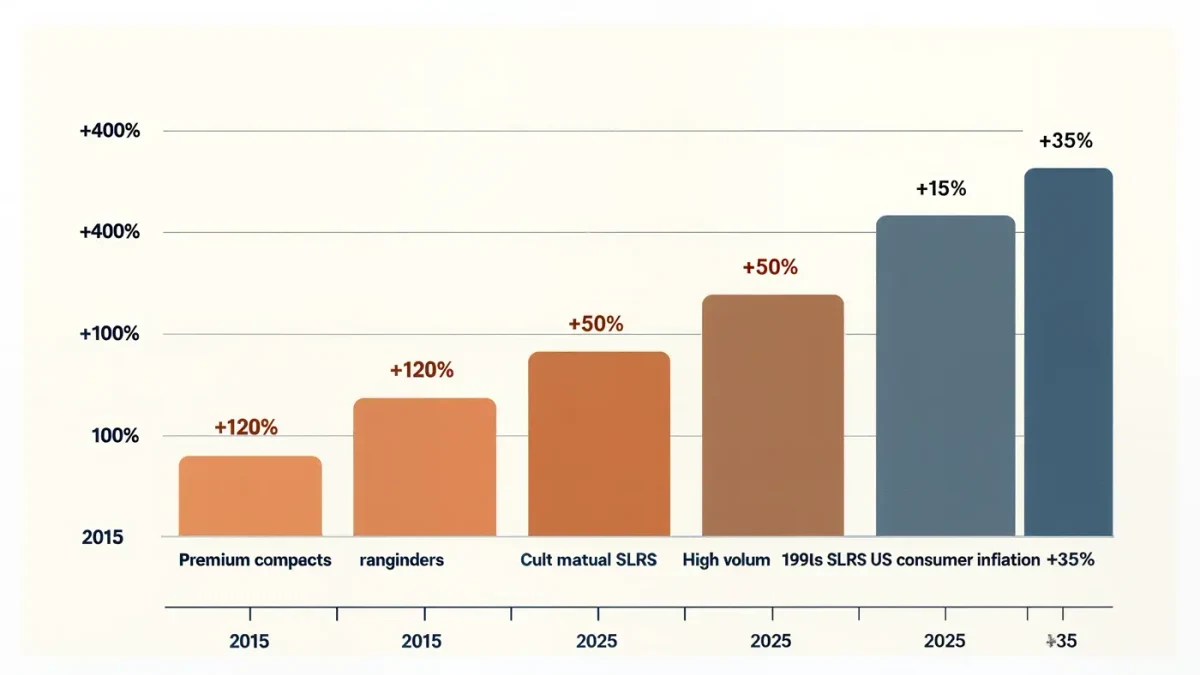
Premium compact cameras roughly quadrupled between the mid-2010s and 2025: a Contax T2 that listed used around $300 trades near $900-1,500 in rounded marketplace data as of 2025, while US consumer prices rose about a third over the same decade, per Bureau of Labor Statistics data. Some cameras climbed far harder than inflation; most climbed much less.
Price history explains the market's logic; it promises nothing about the next decade. What follows is rounded, condition-dependent data from major marketplace listings, as of 2025.
Which bodies climbed the most?
The used market did not rise evenly — it stratified by scarcity, fragility and reputation.
| Category | Mid-2010s, rounded | As of 2025, rounded |
|---|---|---|
| Premium compact (Contax T2, T3) | $250-350 | $900-1,500 |
| Compact workhorse (Olympus mju-II) | $60-100 | $250-450 |
| Leica M6 classic | $1,800-2,400 | $3,500-5,000 |
| Cult manual SLR (Nikon FM2) | $150-250 | $300-500 |
| Volume SLR (Canon AE-1 body) | $80-150 | $150-300 |
| Medium format system (Mamiya RZ67 kit) | $400-600 | $500-900 after a 2021 peak |
Two patterns stand out. First, the steepest gains concentrated in compact cameras — machines with electronics that cannot be economically repaired. Second, nothing mass-produced from the 1970s and 1980s became truly expensive; supply is simply too deep.
Why did premium compacts lead?
Three forces converged on the compact segment. Demand came from visibility: from the mid-2010s onward, high-profile street photographers and celebrities were repeatedly photographed with Contax T2 and T3 bodies, and each appearance moved search traffic and prices. Supply was fixed: autofocus compacts stopped being designed in the 2000s, and the only genuinely new film compact since, Ricoh's Pentax 17 half-frame announced in June 2024 at $499, is a manual-focus camera in a different class. And mortality ran one way: the flex cables, shutters and LCDs of a 1990s compact fail with age, failed boards have no parts pipeline, and every dead body permanently shrinks the pool.
What held SLR prices back?
Millions of manual SLRs were built across three decades, so the shelf never empties. More importantly, they are repairable: mechanical shutters respond to a standard clean-lubricate-adjust, which traded around $100-250 as of 2025, and parts donors are cheap. A buyer who wants an FM2 or a K1000 can always find a working one, and that ceiling on scarcity caps prices. The Leica M system sits apart because its bodies held collector value even at the bottom of the market, and Leica's own M6 reissue of November 2022, listed at $5,295, quietly set a floor under used classic prices.
What role do repairs play?
Repair economics sit under the whole market like a foundation. A clean-lubricate-adjust on a mechanical shutter — the standard service that keeps FM2s, K1000s and Pentaxes alive — traded around $100-250 as of 2025, with light-seal foam kits adding $30-60 and meter recalibration more. That service cost anchors used prices from below: a $200 body needing $150 of work is worth roughly $50 to a buyer who knows, and dealers price accordingly. The arithmetic breaks for electronics: a compact whose main board fails is usually a total loss, because nobody manufactures replacement flex cables and LCD ribbons for cameras discontinued two decades ago. Repairable cameras depreciate gently; unrepairable ones cliff.
The repair bench itself became a bottleneck. The technicians who trained on these machines in the 1980s are retiring faster than apprentices arrive, and backlogs at established shops stretched to months through the revival. Backlog is a hidden tax on the market: when service waits run long, working, already-serviced bodies command premiums far above parts-and-labor math, which is a big part of why dealer listings with warranty histories sit at the top of every price range in the table above.
Where do used camera prices actually get set?
Price discovery happens across three venues with different mechanics. Auction platforms set the volatile wholesale-ish baseline: real bidders, real risk, condition gambles. Specialist dealers — the KEH, MPB and UsedPhotoPro tier — buy below auction, service or grade what they take, and sell with warranty at a 20-40 percent premium, which is the price of certainty. Japanese exporters form the third pole: deep domestic supply, honest grading conventions and aggressive pricing, with freight and import risk on the buyer. As of 2025, spreads between these venues for the same model ran wide enough that patient cross-shopping effectively paid for a CLA.
What does condition do to the sticker?
In this market, condition is the price. The same T2 spans a wide range depending on whether the viewfinder is clear, the seals are fresh and the light meter agrees with a phone app. Foam rot, lens fungus and haze, corroded battery compartments and jammed winders sort every listing into tiers, and dealers with warranty command a premium over auction gambles. Medium format tells the cautionary tale: Mamiya RZ67 and Pentax 67 kits spiked with the 2020-2021 revival wave, then corrected by rough quarters as import supply caught up — a reminder that used gear overshoots in both directions.
Is the market cooling?
By 2024-2025, listing data pointed to a plateau rather than a crash. Compact prices stopped making the leaps of 2017-2021 but did not retreat to pre-hype levels; SLR and medium-format prices drifted sideways with condition spreads widening. The buying logic has matured with it: the market now pays reliably for serviceability, glass quality and system depth, and discounts brutally for dead electronics. Cameras bought as tools held value better than cameras bought as flips.
The honest summary for anyone shopping: the bargains of 2015 are gone, but so is the panic. Prices reflect scarcity that is real — nobody is making another T2 — filtered through a repair economy that decides which bodies survive at all.