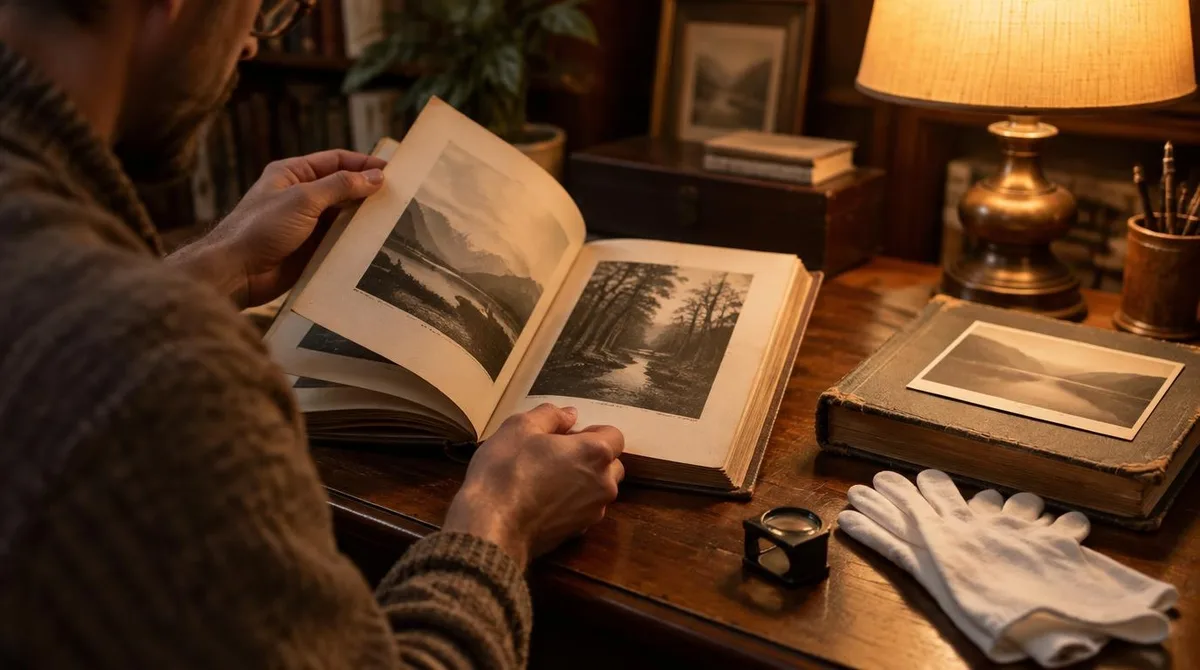
Collecting vintage photography books starts with a simple trade: condition and history decide the price, not the cover art. Few early photo books survive, per Wikipedia’s photo book entry, because light and handling wear them out. Robert Frank’s The Americans, first published in France in 1958, shows how a classic is born.
The field rewards patience more than money. A starter who learns three things, what counts as a photo book, why survival sets the price, and how one famous title turned its luck, can build a shelf with confidence and without a vault. We covered a connected angle in Art News Magazine: How to Read the Art News Without Getting Overwhelmed.
What Counts as a Photo Book
Start with the definition, because it is wide. Wikipedia’s photo book entry calls a photo book any book in which photographs make a significant contribution to the overall content. Museum titles and mass-market volumes sit under the same roof. The lineage runs deep, too. Anna Atkins created what is arguably the first photo book, Photographs of British Algae: Cyanotype Impressions, issued in parts from 1843 to 1853 as a tool for scientists. William Henry Fox Talbot followed with The Pencil of Nature, released in six parts between 1844 and 1846, per the same entry. Readers following this should also see The Art Market for Film Prints.
Why Survival Sets the Price
Old books are rare for a plain reason: they fall apart. Early titles carried photographic prints tipped in by hand rather than printed on the page, and many ran in very small editions sold in parts to a small circle of readers, per Wikipedia’s photo book entry. Few original examples survive today, because light and frequent handling destroy them.
Even a landmark could stall. Talbot expected a commercial win, set up purpose-made printing works in Reading, and watched his subscriber list shrink until the project ended early, per the entry. A complete set of all six parts is therefore a genuine find.
The Benchmark: Robert Frank’s The Americans
Every field needs a measuring stick, and this one has a famous one. Frank took 28,000 shots on his Guggenheim road trips and picked only 83 for The Americans, per Wikipedia’s entry on the book. It first appeared in France in 1958 and reached the United States the following year.
The early press hated it. Popular Photography derided the pictures as meaningless blur, grain, muddy exposures, drunken horizons and general sloppiness, per the same entry. Sales started poor. Then Jack Kerouac wrote the introduction to the American edition, the Beat audience found the book, and the title slowly became a landmark of American photography. The collecting lesson sits right there: the reviews of one decade do not set the market of the next.
A Starter Shelf Without a Fortune
Scarcity is not the only force at work; print runs matter too. Wikipedia’s photo book entry notes that Santa Fe, a 1991 Japanese title photographed by Kishin Shinoyama, sold 1.5 million copies in the early 1990s. Books made in such numbers stay easy to find and kind to a starter budget.
Three habits make the first purchases safer.
- 1. Check completeness. Many early books were sold in parts, and an incomplete set tells only part of the story.
- 2. Judge the wear. Light fade and soiled corners are the very damage that Wikipedia names as the enemy of survival.
- 3. Read the field. Wikipedia’s entry leans on Martin Parr and Gerry Badger’s The Photobook: A History, and those volumes remain a standard map of the territory.
Conclusion: Buy the Book’s Story
Collecting vintage photography books rewards the same qualities the books hold: patience, condition, and a documented past. Start with the definition from Wikipedia’s photo book entry, hold every candidate against the light-damage test, and study how The Americans went from poor sales to landmark status. A shelf built that way runs on evidence, not luck, and it only gets better with age.