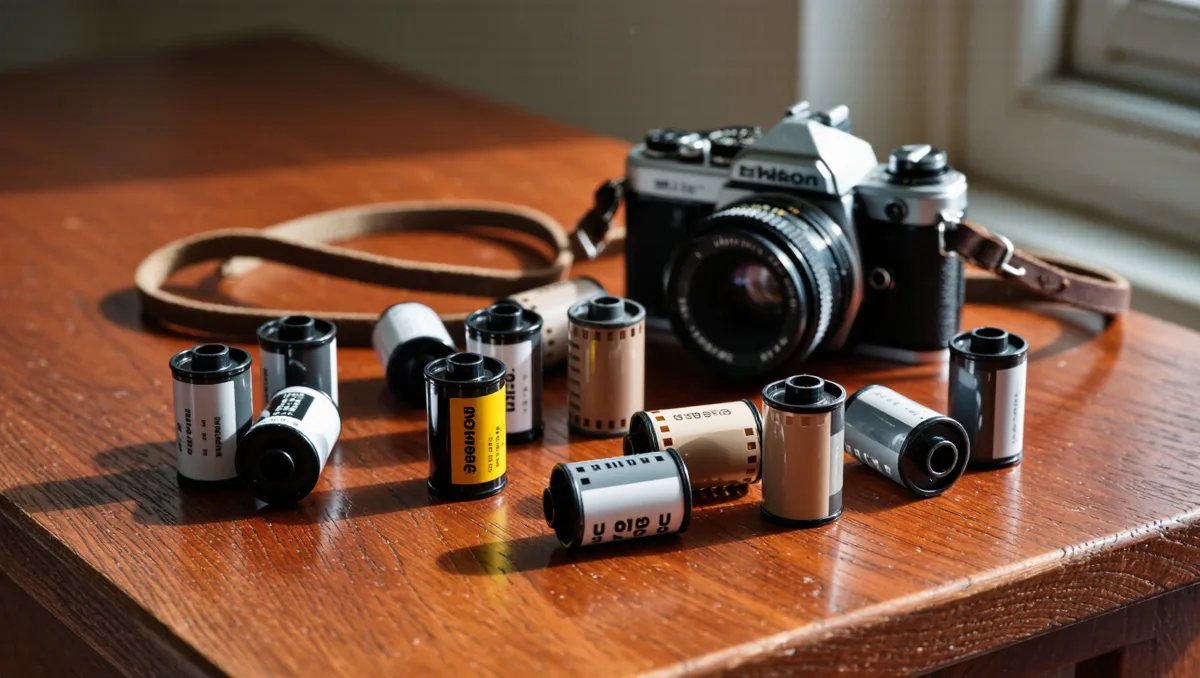
A changing bag trades a darkroom for two zippered layers over the arms — enough darkness to load a tank anywhere. Per Paterson's documentation, a Super System 4 tank processes one 35 mm roll with 290 ml of solution (Paterson, as of 2024). As of 2025, a double-layer bag runs roughly $25-60, and loading takes under two minutes practiced.
How do you set up a changing bag before starting?
Everything goes in before the film does, laid out in a fixed order that fingers can learn. The routine never changes: opener and scissors on one side, tank pieces in the middle, film at the cuff. Once zipped, the bag is a darkroom — nothing enters or leaves until the tank is closed.
- Inspect the bag in a lit room: zippers running full length, cuffs elastic intact, no worn seams or pinholes anywhere light could pass.
- Do one complete dry run in the light with a junk roll — through opener, cut, load, lid — until the order feels automatic.
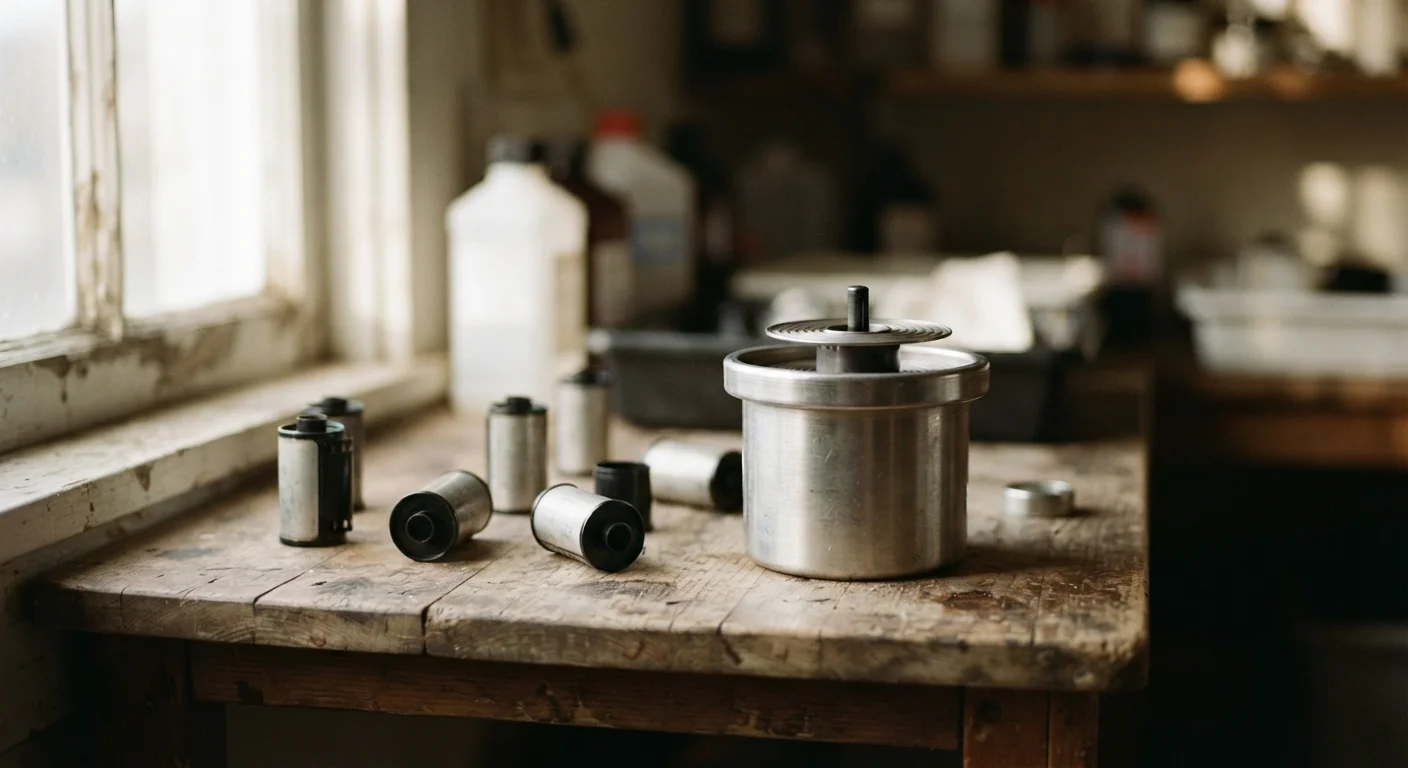
- Place the bottle opener and small scissors at one side, the opened tank base, spiral, and lid in the center, and the film at the near edge.
- Push both arms through the cuffs, zip the inner zipper, then the outer one, and settle the bag on a stable table.
- Move to the dimmest side of the room — a lightproof bag deserves a dim room too.
Table height matters more than it sounds: the bag's cuffs pull taut when the surface is too high, and fighting elastic mid-load causes exactly the fumbling the layout was meant to prevent. A table at seated elbow height keeps two arms' worth of slack in the fabric.
How do you load a reel by touch alone?
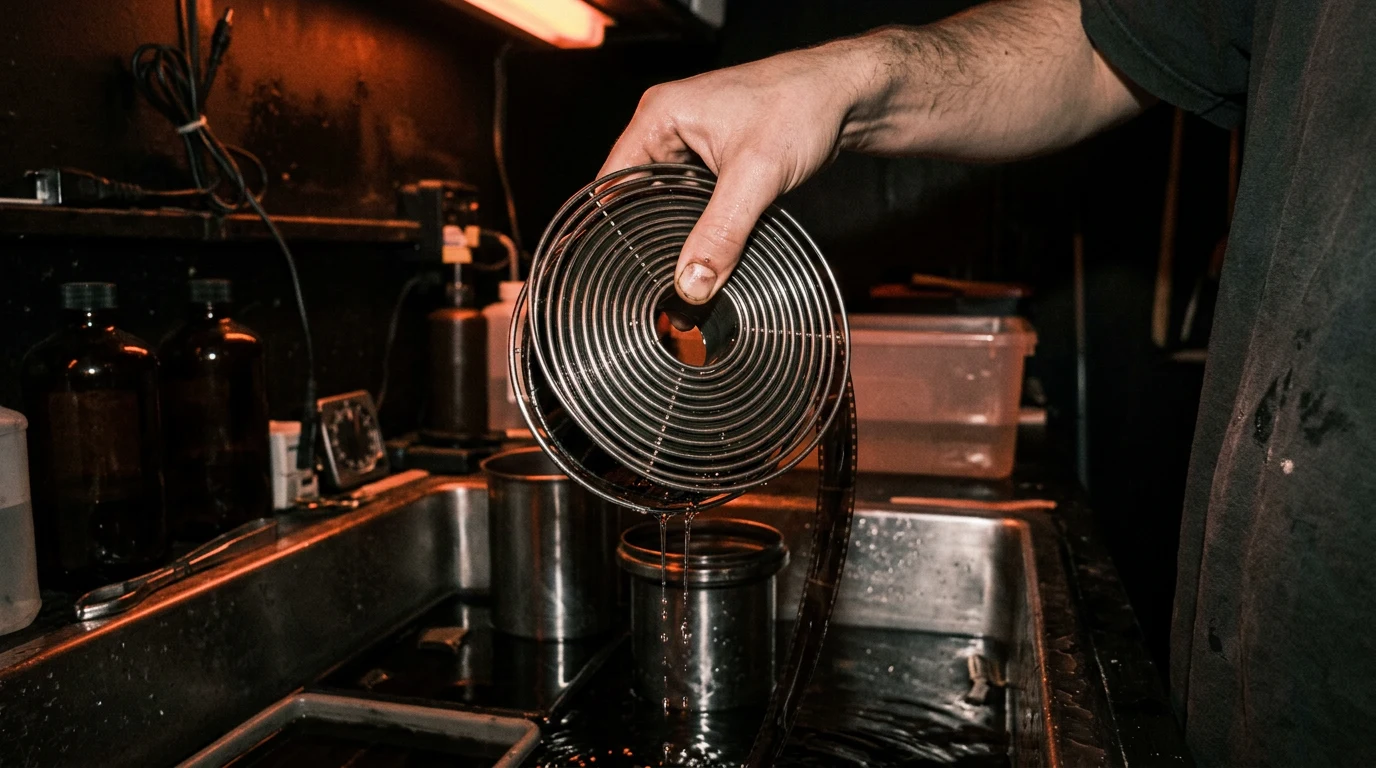
Feed, walk, cut. Crack the canister, pull the film out a hand-width at a time, cut the tongue square, feed the end into the spiral, then rotate the reel's halves back and forth so the film walks itself in to the end. Trim the spool off, drop the spiral in the tank, cap it.
- Pop the canister end with the opener, and feel the film spool drop loosely inside.
- Draw the tongue out ten to fifteen centimeters and cut the narrow leader off square with the scissors.
- Feed the squared end under the spiral's clips and center it on the track.
- Walk the reel — alternate rotating the halves a quarter-turn each way, and the film ratchets itself inwards in even loops.
- When the film stops, find the spool, cut the film free, walk in the last hand-width, then seat the spiral on the column and screw the lid down tight.
What happens if the film jams in the reel?
Stop and back it out. Forcing a jam crimps the film — a permanent crease that prints as a dark lightning mark. Eject a hand-width, straighten the film between fingers, and start the section again. In humid weather emulsion grips emulsion; going slower is faster than going twice.
Jams have three usual causes: a tongue that was never cut square, film pulled out faster than the reel accepts it, and damp emulsion sticking to itself. The first two are technique and disappear with practice; the third is environmental, and a cooler, drier room fixes it. Every experienced loader has crimped one roll — the goal is exactly one.
A crimp is not always fatal: if the crease falls between frames or in sky, the roll still prints. It is permanent, though — emulsion stretched once never lies flat again — so treat every jam as the last one worth having.
Changing bag or changing tent?
Both are darkrooms; the difference is architecture. A bag is fabric that drapes over whatever is inside — including film standing upright in a spiral. A tent's rigid frame holds the fabric away from the work, which matters for 120 and for anyone who fights the material. Bags cost less and pack flat; tents buy elbow room.
For 35 mm only, a standard double-layer bag is entirely adequate and half the price. The moment 120 enters the picture — wider reels, a backing paper strip to wind off, more fabric volume — a frame tent stops being a luxury. Either way the rule holds: practice with a wasted roll first, film that matters second.
Sleeves exist too: lighttight bags with a double closure for film storage rather than loading, and cardboard changing tents that fold like maps. For a first setup, one honest double-layer bag covers every need short of sheet film.
What else is a changing bag good for?
Anything that needs darkness for a minute rather than an hour: loading sheet-film holders, transferring film to a daylight tank mid-roll, unloading a camera in bright sun, and rescuing a roll that rewound entirely into its canister. The bag is a general-purpose portable darkroom — the tank load is simply its audition.
Sheet-film holders are the classic second use: slides load two sheets each in darkness, and a bag plus a clean table replaces a whole darkroom for large-format trips. The discipline transfers directly — fixed layout, dry run, no jewelry — at a slightly larger scale of fumble.
Mid-roll transfers are the expert-level trick: rewind gently until the leader detaches from the take-up spool but stops short of the canister, and the remaining frames live for another day. It demands feel and a camera that cooperates, which is why the junk roll earns its keep before this trick.
What are the most common changing bag mistakes?
Most disasters are setup disasters: the scissors left outside, the bag checked in a bright room years ago, the inner cuff riding up a wrist mid-load. The bag forgives none of them. A five-minute inspection and one dry-run roll prevent nearly everything on this list.
- Skipping the light test. Put a lit flashlight inside the zipped bag in a dark room; any glow at seams or zippers is a fogging bag.
- Random layout. Fumbling for the lid mid-load knocks the tank over; the fixed order exists so nothing must be found.
- Jewelry on the loading hand. Rings and watch edges scratch emulsion that cannot be seen.
- Working beside a bright window. Even good bags gain margin in a dim corner.
- Hot, sweaty hands. Damp fingers make emulsion tacky and jam reels; take breaks, dry palms, slow down.
Once the layout is fixed and the fingers trained, the changing bag stops feeling like an ordeal and starts feeling like a superpower: developing film on a kitchen table, in a hotel room, at a friend's house — anywhere with a flat surface and two arms' worth of darkness.
The junk roll is the tuition: load it, unload it, load it again, all in the light, until the fingers stop asking the eyes for help. One evening of practice converts the bag from an anxiety into equipment.