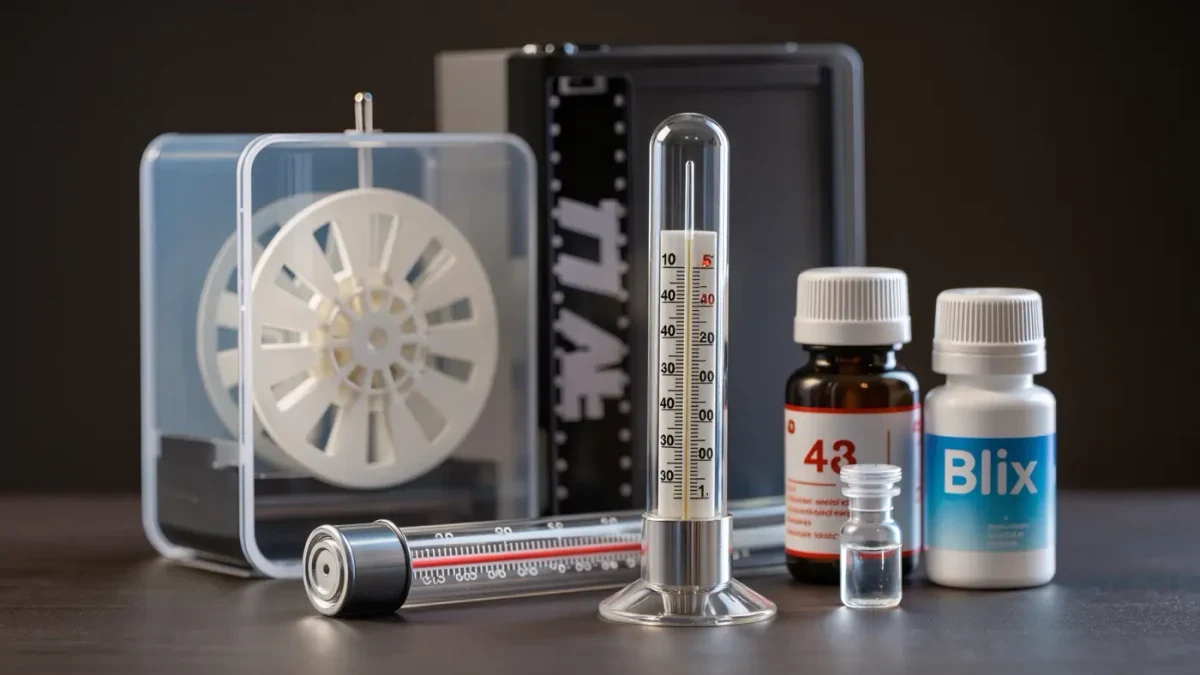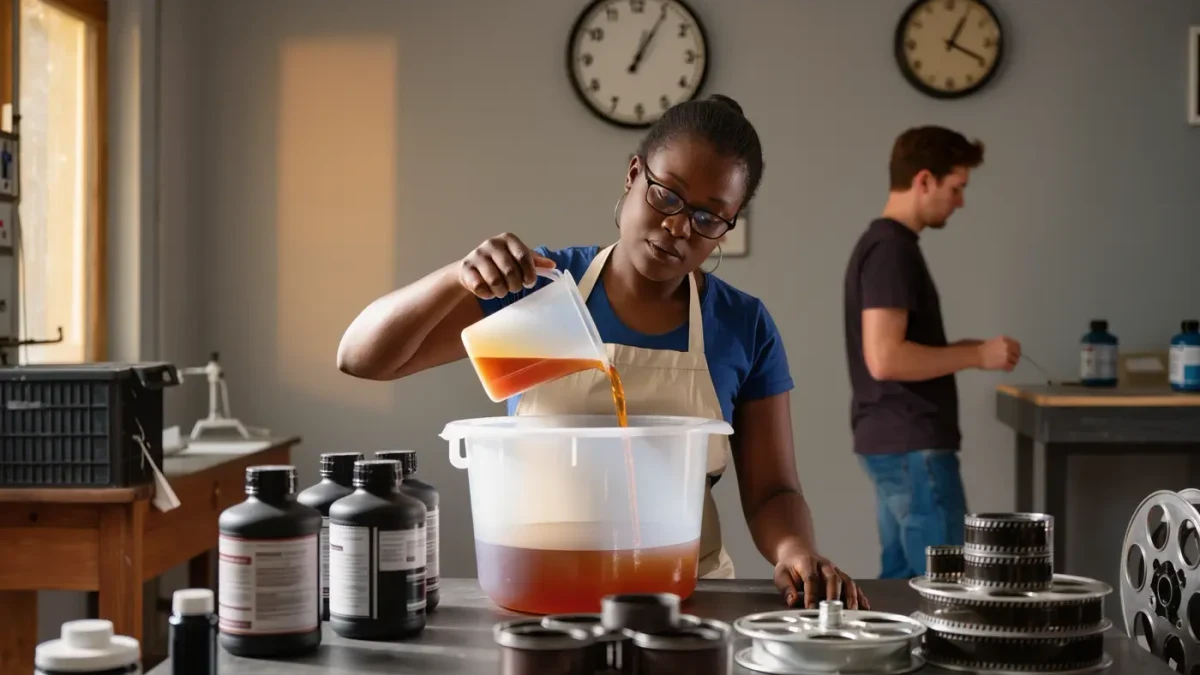
Stand development in Rodinal means one dilution, one hour, and nearly zero agitation: 1:100 at 20 °C for about 60 minutes. Adox's technical data for Adonal, the current Rodinal-type concentrate, lists dilutions down to 1:100 with times approaching a full hour (Adox, as of 2024). As of 2025, a 500 ml bottle runs roughly $30-40 and develops dozens of rolls.
What is stand development, exactly?
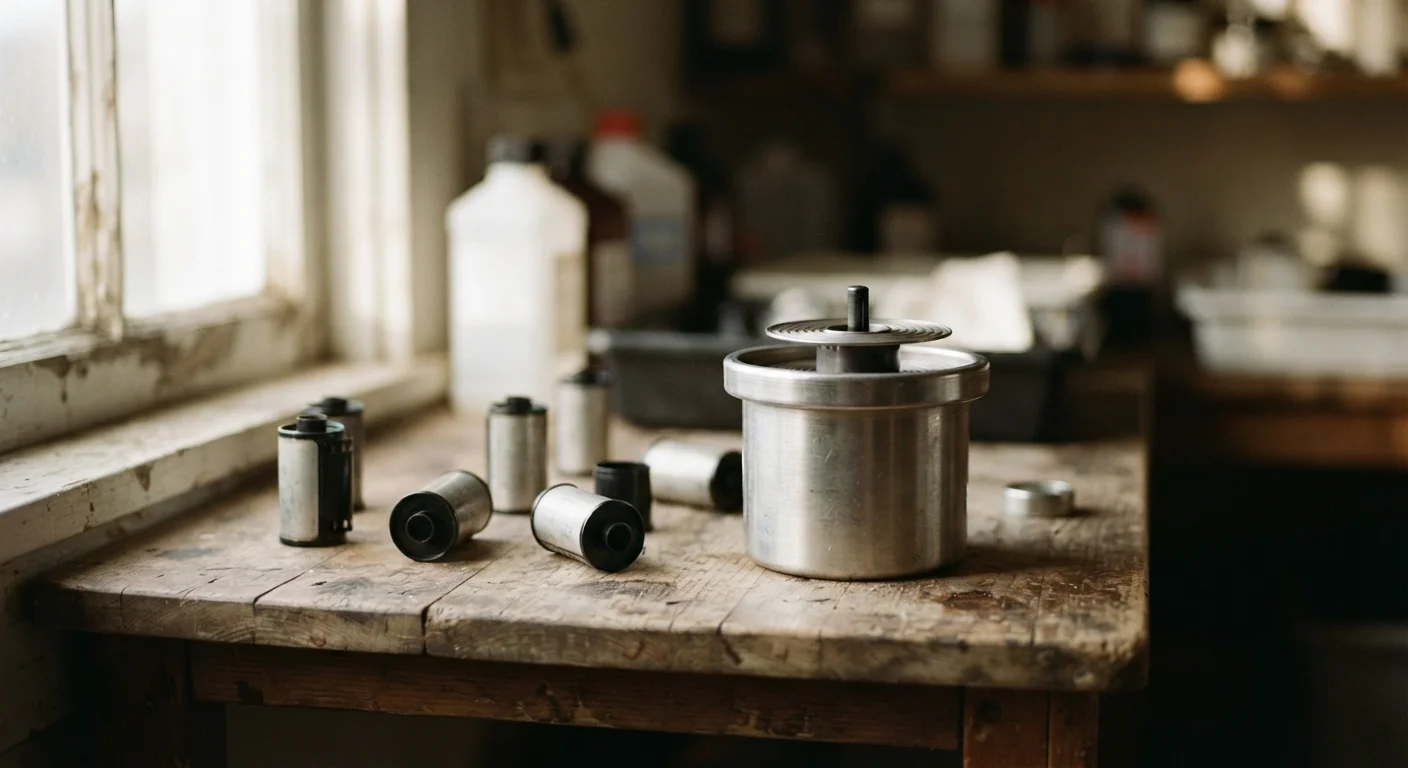
Stand development is normal tank development pushed to extremes: a dilute developer and a very long time with the tank sitting still. The weak solution exhausts quickly in dense highlight areas but keeps working in sparse shadows, which compresses contrast — the compensating effect. Minimal agitation also builds edge effects between adjacent densities, which reads as unusually crisp grain boundaries.
The formula itself is the oldest product in photography: Rodinal appeared in 1891, and today's equivalents — Adox Adonal and Compard R09 — follow the same p-aminophenol concentrate recipe. At 1:100 the solution is mostly water, and that is what creates the forgiving behavior: there is barely enough active chemistry to saturate a dense negative, so highlights develop to a ceiling while thin shadow areas catch up.
How do you run a Rodinal stand development?
Dilute 1:100 at 20 °C, agitate for the first 30 seconds, then leave the tank untouched for a full hour. That is the whole method: pour, agitate once, walk away, then stop or rinse, fix, and wash as with any black-and-white film. Total hands-on time is under five minutes.
- Measure 5 ml of concentrate into 500 ml of 20 °C water. A syringe beats guessing, because 4 ml versus 6 ml is a real difference at this dilution.
- Presoak the film for one minute in plain water if the tank and reel are cold; it evens out the temperature before the developer goes in.
- Pour in the developer and agitate continuously for the first 30 seconds, then tap the tank once on the bench to dislodge air bells.
- Do nothing for 60 minutes. No inversions, no rotation. Some shooters perform one gentle inversion at the 30-minute mark — semi-stand — for slightly more even results.
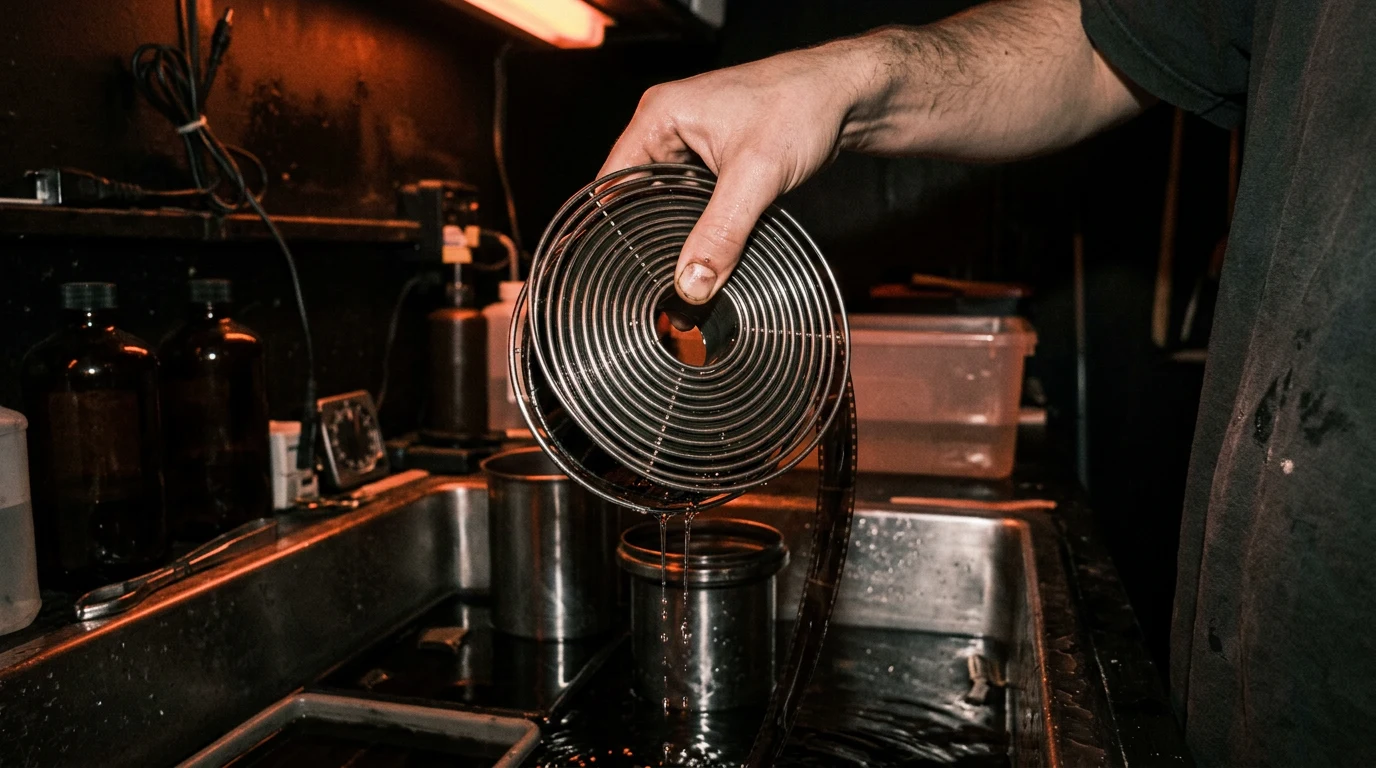
- Pour out, rinse twice with water, then fix for your fixer's normal time and wash as usual before hanging to dry.
Which films suit stand development?
Cubic-grain classics and problem rolls. Ilford HP5 Plus, Kodak Tri-X, Fomapan 100 and 400, and Kentmere 400 all behave at 1:100 for an hour, and expired film or rolls that need a one-stop push are the classic use case. Modern tabular-grain emulsions — T-Max, Delta — can come out gritty and flat instead.
| Film | Box speed | Time in Rodinal 1:100 at 20 °C |
|---|---|---|
| Ilford HP5 Plus | ISO 400 | 60 minutes, stand |
| Kodak Tri-X 400 | ISO 400 | 60 minutes, stand |
| Fomapan 100 | ISO 100 | 60 minutes, stand |
| Kentmere 400 | ISO 400 | 60 minutes, stand |
Community-verified entries on the Massive Dev Chart (Digitaltruth, as of 2025) put most 400-speed classics at one hour; treat any single time as a starting point, not a law.
Fomapan benefits most among budget stocks: its generous latitude and old-school cubic grain suit the compensating window, and its price as of 2025 — roughly $5-7 a roll — makes experimentation cheap. Kentmere 400 behaves similarly for similar money.
Can stand development rescue expired film?
Often, yes — that is its best trick. Expired film has lost speed unevenly, and a normal developer just records the loss. An hour of weak compensating developer keeps feeding the faint shadow areas long after highlights have hit their ceiling, pulling usable density from emulsions a standard time would leave nearly blank.
Rate the film at half its box speed, or one stop down for every decade of unknown storage, and stand-develop as usual. Fog is the trade-off: old emulsions accumulate base fog over years, and the long time develops that haze along with the image. Expect softer contrast and grain that reads coarser than fresh stock — the look many shooters deliberately choose for found film.
The same logic covers mixed-speed rolls shot on one body, rolls found in inherited cameras with no exposure record, and film of unknown storage history. When nothing is known about the negative, the developer that forgives the most is the developer to trust.
What happens if you agitate during stand development?
Contrast rises and the compensation fades. Each inversion delivers fresh developer to exhausted highlight areas, so dense regions keep building density. Agitation also stirs up bromide — a development by-product that streams across the emulsion — which can leave streaks and surge marks near sprocket holes. One gentle inversion at 30 minutes is the tolerated middle ground.
The practical pattern to remember: agitation is a dial between evenness and compensation. Continuous agitation gives conventional, slightly denser results; total stillness gives maximum compensation with a small risk of uneven development from stagnant chemistry. Semi-stand with one mid-cycle inversion splits the difference and is what most home darkrooms settle on after a few rolls.
Stand development also forgives timing drift in a way normal development never does. Because the chemistry is nearly exhausted after the first minutes, a tank that sits 55 minutes or 70 minutes instead of 60 produces surprisingly similar negatives. That margin is the reason the method suits slow evenings and interruptions — and why precise timing matters least in exactly the process where it seems to matter most.
What are the most common Rodinal stand mistakes?
Most failures trace back to measuring, temperature, or expectations. Five ml of concentrate in half a liter is a small target, cold rooms slow everything down, and Rodinal's grain is honest rather than fine. The mistakes below account for nearly every ruined roll.
- Guessing the dilution. Use a syringe; a 20 percent measuring error at 1:100 changes negative density visibly.
- Cold chemistry. A 17 °C bathroom can stretch an hour toward ninety minutes. Warm the water to 20 °C before mixing.
- Reusing the working solution. One-shot only — the dilution is spent after a single roll.
- Expecting fine grain. Rodinal is an acutance developer; expect visible, crisp grain, especially at box speed.
- Skipping the bench tap. Air bells cling to emulsion in an unagitated tank and print as black dots.
Handling notes: the concentrate is a strongly alkaline p-aminophenol solution. Nitrile gloves, ventilated mixing, and a rinse under running water after any skin contact are the basic routine. Spent developer is usually dilute enough for drains in many municipalities, but check the EPA's household hazardous waste guidance and local rules first.
Stand development will not replace properly timed normal development for critical work, but as insurance for expired film, mixed-speed rolls, and slow evenings it is unmatched: pour once, wait an hour, fix, wash. Few processes in photography give this much margin for this little attention.