Vintage camera collecting has a fake problem. Replicas, parts-bin rebuilds and mislabeled bodies sit in market stalls and online listings right next to the real thing. The good news: most fakes give themselves away if you know where to look.
This guide walks through the three main traps — outright replicas, franken-cameras assembled from mismatched parts, and honest cameras wearing the wrong nameplate. None of it requires special tools. It requires slowing down and looking.
If you are still choosing which body to hunt for in the first place, our guide to how to choose your first film camera covers the basics. This piece assumes you have a target and want to avoid buying a dud. We covered a connected angle in How to Choose Your First Film Camera: A Beginner's Guide.
What are the three kinds of fake?
The first kind is the replica. A modern factory makes a lookalike of a famous camera and sells it as the real thing. These cluster around iconic, expensive names, because that is where the profit is.
The second kind is the franken-camera. A seller combines parts from several donor bodies into one that looks complete. The serial numbers do not match. The top plate comes from one camera, the film door from another, the internals from a third. It may work fine. It is still not what the listing says it is.
The third kind is the mislabeled classic. This one is often not a scam at all. A cheaper model from the same maker gets badged or described as its famous sibling. An honest seller may simply not know. A dishonest one is counting on you not knowing.
What should I check on the body itself?
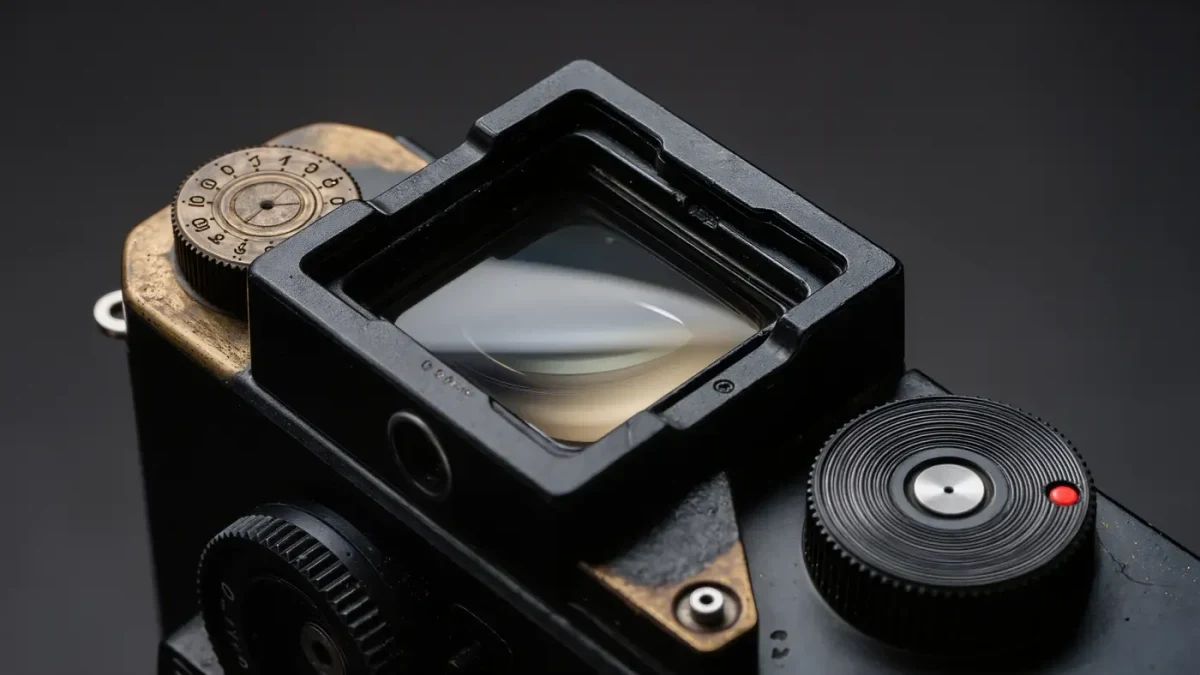
Start with the materials and the fit. Older cameras were built with tight panel gaps, even paint and crisp engraving. Replicas often feel light in the hand. The engraving may be shallow, with soft edges or uneven letter spacing. Run a fingertip over the nameplate. Real engraving has a slight bite you can feel.
Look at the screws. A camera advertised as untouched should not show fresh tool marks on slot heads. Scratched-up screw slots around a plate that should never be opened suggest a previous repair — or a parts swap. Fresh, bright screw heads on a worn body are a classic red flag.
Check the covering. Original leatherette sits flush and follows the body contours cleanly. Replacement covering is often slightly the wrong texture, cut too thick at the edges, or trimmed short of where the original reached. It is not proof of a fake by itself. Old cameras get re-covered. But it tells you the body has been opened up or refinished, and that changes how you read everything else.
How do serial numbers and badges help?
Serial numbers are your best friend in vintage camera collecting. Most makers kept records, and collector communities have published the ranges online. The number should appear where the maker put it — often stamped into the top plate, not printed on a sticker. A number that looks newly engraved, sits in the wrong spot, or repeats a pattern you have seen on other listings deserves suspicion.
Match the number to the features. Makers changed small details across production runs: shutter types, top-plate layouts, rangefinder windows. If a camera carries a serial number from an early run but features from a late one, parts have likely been swapped. That is the franken-camera signature.
Badges tell their own story. A nameplate that is crooked, glued rather than riveted, or slightly the wrong typeface points to a re-badged body. Some cheaper models were deliberately badged differently for different markets. Knowing those variants is part of the homework for any serious purchase.
Nothing on a used camera should be taken on faith. The nameplate, the number and the features all have to agree — and when they do not, you have your answer.
What does a working check look like at the stall?
You cannot fully test a camera in five minutes. You can rule out obvious problems. Ask the seller to open the back and dry-fire the shutter at a few speeds while you listen. The sound should change across the speed range. A shutter that sounds identical at every setting has a problem, even if the listing says the camera "seems to work."
Wind the film advance. It should move smoothly and stop with a positive feel. Check the light seals: black foam that has turned sticky or crumbled into the film chamber means a service is due, and that cost belongs in your offer. Look through the lens at a light source and check for haze, fungus or deep scratches. A little dust is normal on an old lens. Spiderweb patterns or fuzzy patches inside are not.
Practical steps, in order:
- Confirm the serial number against published maker records before you buy.
- Fire the shutter at several speeds and listen for clear differences.
- Inspect the lens glass against a light for haze and fungus.
- Check the film compartment for crumbling seals and corrosion.
- Ask directly what has been repaired, and note whether the answer matches the tool marks you can see.
How do I vet an online listing I cannot touch?
Online buying removes the touch test, so lean harder on photos and the seller. Demand pictures of the serial number, the shutter curtains or blades, the lens elements, and the film compartment. A seller who refuses those shots is telling you something.
Compare the listing photos against known references for the model. Collector forums and maker archives publish detailed images of genuine examples. Look at the typeface on the nameplate, the position of the serial number, the shape of the strap lugs. Small mismatches add up.
Read the description the way a skeptic would. "Working condition" is not a promise. "Untested, sold as-is" means you are buying a gamble and should price it like one. "Fully serviced" should come with a name — who serviced it, and when. Vague confidence is itself a red flag.
What this means for your first purchase
Our analysis across the traps above points to one habit: buy the seller as much as the camera. Established dealers put their reputation on every sale. Market stall sellers who let you handle the body and answer questions plainly are worth a small premium over an anonymous listing with one blurry photo.
Start your hunting with models that are common enough that fakes are rare and reference material is rich. The Pentax K1000, the Canon AE-1 and the Nikon FM2 all have deep documentation and large user communities, which makes mismatches far easier to spot. Rarer, pricier bodies reward deeper homework before you commit — our Leica M6 buying guide is a good example of what that research looks like in practice. Readers following this should also see Canon AE-1 Buying Guide: Worth It?.
And remember that a camera is a working machine, not a display piece. Whatever you buy, you will want film for it — our film section covers what to load. A fake that shoots is annoying. A genuine camera that cannot shoot is worse.
The takeaway
Fakes in vintage camera collecting fall into three buckets: replicas, franken-cameras and mislabeled classics. Each leaves evidence. Engraving that feels wrong, screws that look freshly turned, serial numbers that contradict the features, coverings that do not sit right — these are the tells. Handle before you buy where you can. Demand detailed photos where you cannot. Match every number and badge against published references. Slow down, ask questions, and treat vague answers as data. The honest cameras vastly outnumber the dishonest listings. The looking is what separates them.