A super 8 film camera is one of the friendliest ways into motion picture film. The cartridge loads in seconds, the camera handles exposure for you on most models, and the whole system was designed in an era when families, not film schools, were the customer. The catch is not the shooting. It's the ongoing cost of film and processing, which is the real budget decision you're making.
So where do you start? Pick a simple, well-made used body from a major maker, buy fresh film, plan on paying a lab for every roll, and keep your first projects short. This guide walks through the models worth looking at, what the film habit actually costs, and the practical habits that separate a watchable first roll from a shaky, fogged disappointment. Readers following this should also see Cameras for Photography — How to Choose Your First Film Camera: A Beginner's Guide.
What exactly is a Super 8 camera?
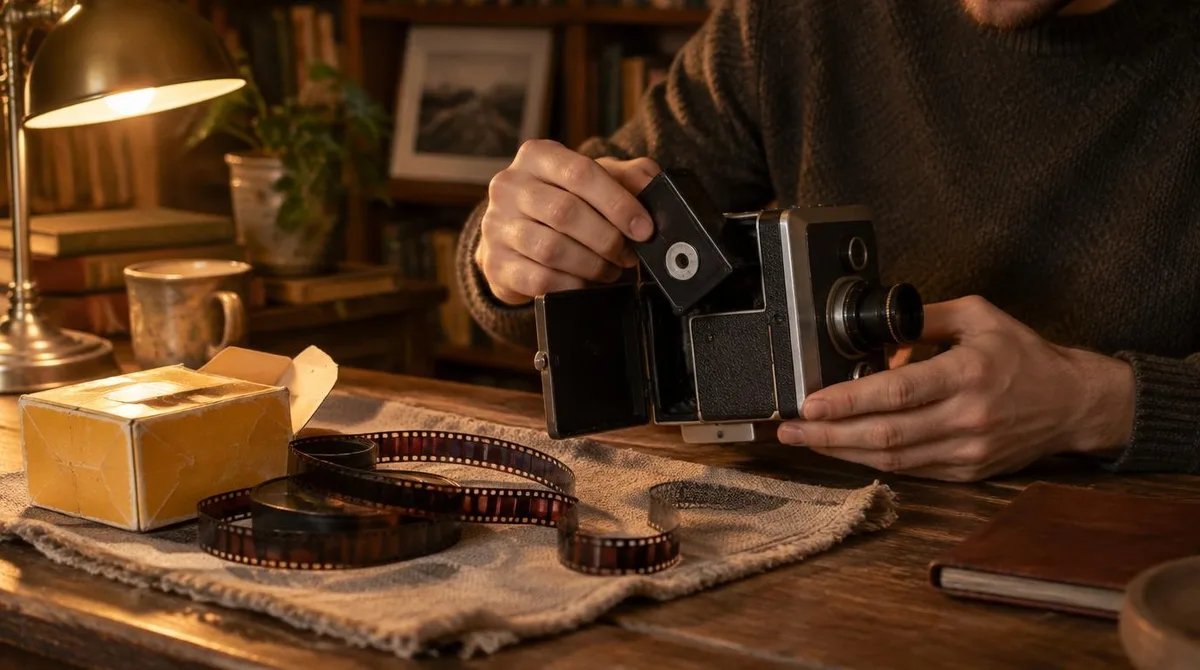
Super 8 is a motion picture film format that Kodak built around a self-contained cartridge. You drop the cartridge in, pull a winding advance if the camera has one, and you're loaded. The film runs at a modest frame rate, the cartridges are short, and the plastic housing protects the film from light the whole way through. Compare that with 16mm, where you thread the film yourself in the dark, and you can see why beginners land here.
The word itself is older than the format, of course. According to the Cambridge Dictionary, "super" long ago picked up the everyday sense of excellent or very large, which is roughly the promise the format made: home movies, but better.
Because the cartridge does the fussy work, a Super 8 camera mostly asks you to do three things: hold it steady, frame the shot, and let the built-in meter decide the exposure. That simplicity is why the format survived the video era and why used bodies still circulate in useful numbers.
Which models are worth your money?
The used market divides neatly into three tiers, and knowing which tier you're shopping in prevents most buyer's regret.
- Simple family zooms. Kodak, Canon, Minolta, and Chinnon made thousands of point-and-shoot style bodies with fixed zoom lenses and automatic exposure. These are the cheapest way in, and for a first roll they are honestly enough. The trade-off is limited manual control and, on fifty-year-old electronics, some repair risk.
- Serious consumer and prosumer bodies. Think Canon's higher-end zooms, Nikon's compact Super 8s, or the German-made Nizo models from Braun, which are prized for their lenses and build. These cost more, offer better glass and more control, and hold up well if they've been stored kindly.
- Collector territory. Beaulieu and other exotic French and German designs are beautiful machines with fragile, hard-to-service internals. Admire them, but they are a poor first camera.
Whatever tier you shop in, the same used-buying checks apply as with any vintage body: test the battery compartment for corrosion, listen for a smooth motor, and check that the lens is clear of haze and fungus. Our guide to buying a used film camera without getting burned covers the full inspection routine, and most of it transfers directly to Super 8. We covered a connected angle in Cameras for Sale: How to Buy a Used Film Camera Without Getting Burned.
One honest warning: Super 8 cameras are old, and the newest of them is decades past its design life. A camera that runs today can develop a sluggish motor or a sticky pressure plate. Buy the best-condition example you can afford rather than the cheapest one listed.
What does shooting Super 8 actually cost?
Here's the part the romance glosses over. The camera is a one-time purchase. The film is a subscription you can't cancel.
Per roll, your cost has three parts: the film cartridge itself, the lab fee to develop it, and scanning if you want the footage on a drive. Color negative and black-and-white stocks are sold as cartridges, and motion picture labs charge per roll for developing, with scanning billed separately or bundled depending on the lab. Prices move, so check current listings and lab rate sheets before you budget — but understand the shape of the expense: a three-minute roll costs meaningfully more than a 36-exposure stills roll once processing and scanning are added.
Two habits keep the cost sane. First, shoot deliberately. A cartridge gives you a few minutes of running time, so a roll of disconnected five-second clips is money spent on nothing. Second, ask the lab to scan only the takes you'll use. Many labs offer that option, and it trims the bill on every roll.
The film itself is a branch of the same family you already know from stills. Stocks descended from the same emulsions that make film photography what it is — color negative for general shooting, black-and-white for a documentary feel, and reversal film for a punchy, projected look. Reversal stock is less forgiving of exposure error, so beginners are usually better served starting with negative film.
How do you shoot a good first roll?
Motion picture film punishes the habits stills shooters get away with. A shaky frame is a charming photograph and an unwatchable movie. Before you load anything, a few practices make the difference.
- Lock yourself down. Brace against a wall, sit the camera on a stack of books, or use a tripod. Handheld Super 8 trembles visibly, because small frames magnify every wobble.
- Hold shots longer than feels natural. Count several seconds after you think the shot is done. Editing later is easy; the footage you didn't hold is gone.
- Move the camera slowly, if at all. A slow pan should take so long it feels silly while you're doing it. That's the right speed.
- Shoot in good light. These are slow films by modern video standards. Bright overcast and open shade are your friends; dim interiors are where cheap zoom lenses and old meters struggle.
- Keep a shooting log. Note the scene, the light, and the exposure setting per shot. When the scan comes back, that log is how you learn what the camera and stock actually did.
Exposure, luckily, is mostly handled for you. Most Super 8 cameras meter through the lens and set the aperture automatically. Trust it in even light, and save your manual overrides for when you've seen a roll or two come back from the lab. If metering interests you beyond the automatic setting, our piece on metering without a battery explains the underlying reading-the-light skill, which is the same discipline in a different body.
What about processing and scanning?
You cannot develop most motion picture color film at home the way you can process a roll of stills in a darkroom. The chemistry and the equipment are specialized, so the practical workflow is: shoot, mail the cartridge to a motion picture lab, and receive back scanned files and the original film strip.
Choose a lab that scans at a resolution you'll actually use, and tell them the look you're after — labs can push or pull development on some stocks, and scanning choices change the final image as much as the film does. Turnaround takes days to weeks depending on the lab and the season, so plan projects around that lag rather than against it.
The scanned files behave like any video footage. You can cut them in free editing software, grade them lightly, and share them anywhere. The film strip itself, returned as a strip of tiny frames, is a keepsake no digital file replaces.
What this means for your first camera
Super 8 rewards a modest start. A clean, simple used body from a major maker, a fresh cartridge of color negative film, one lab you trust, and a few locked-down, well-lit shots per roll will teach you more than an expensive collector's camera ever will. The format's whole design promise — that anyone could load a cartridge and make a movie — still holds. The only real skill to acquire is patience: with the shutter running, with the lab's turnaround, and with the small monthly cost of making something on film. Start with one roll, watch it on a screen bigger than your phone, and you'll know immediately whether the format is for you.