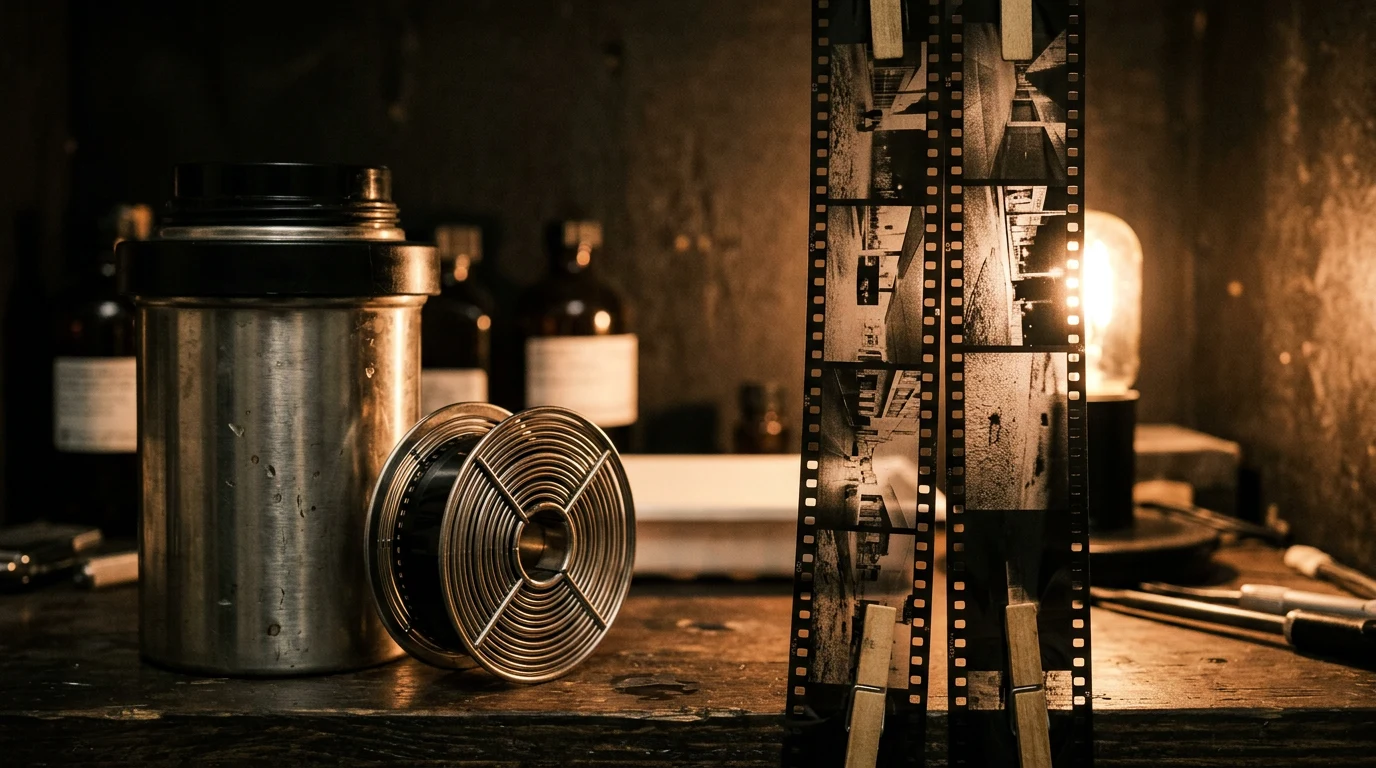
Fomapan 100 is the cheapest widely available 100-speed black and white film in the West, made by Foma Bohemia in Hradec Králové, Czech Republic — a factory coating photographic emulsions since 1921. Rated ISO 100/21° per Foma's datasheet and priced at roughly $5-7 a roll as of 2025, it delivers a classic silver-rich rendering modern T-grain films deliberately left behind.
What kind of film is it, chemically and aesthetically?
Traditional. Fomapan 100 is a conventional silver-halide emulsion of the sort the whole industry shot before tabular grains arrived — thicker coating, generous silver, tonality that rolls in long curves instead of snapping into contrast. Photographically that means gentle midtone gradation, whites that build density like building a silver print, and grain with visible structure that reads as texture rather than noise.
Red sensitivity runs a touch modest by modern standards, which shows up as slightly darker blues in landscape work — skies print denser than a modern film would render them. Shooters of a certain disposition use this as a feature: built-in dramatic sky, no filter required.
The look gets called «classic» so often it has become the product. Landscape and still-life shooters describe a rendering closer to mid-century pictorial photography than to contemporary Ilford or Kodak stocks, and the sheet-film formats Foma still produces anchor that identity in large-format practice, where the brand has a loyal following priced out of nothing else.
| Spec | Value |
|---|---|
| Speed | ISO 100/21° (Foma datasheet) |
| Process | Standard black and white chemistry |
| Emulsion | Conventional silver-rich panchromatic |
| Formats | 35mm, 120, and sheet film |
| Rough price | $5-7 per 36 exposures, as of 2025 |
Is it really ISO 100? The honest-speed question
Here is the standing caveat. Foma's datasheet rates the film 100/21°, but a substantial body of published practice treats it as slower: the Massive Dev Chart carries development entries down-rated to EI 64 and 80 alongside box speed, and long-running community consensus meters it between 64 and 100 depending on developer. In practice this means EI 80 is the safe working rating and box speed is the optimistic one.
Developer choice moves the honest speed, too: published entries and community practice report EI 64 through 100 behaving well depending on chemistry, with speed-building developers reaching the full label and finer-grain ones landing lower. Pick the rating that matches your developer, write it on the canister, and meter without regrets.
This is not unique to Foma — vintage-style emulsions with older hardening and thinner coating technology often meter best below their label — but Fomapan makes the pattern famous. Shoot it at 80, give shadows room, and the film rewards you with the tonal sweep it is famous for. Shoot it at 100 in contrasty light and the thin shadows are on you.
How does it handle light and development?
It wants daylight and patience. At 100 — or rather 80 — the film suits tripods, longer looks, and deliberate work: architecture, landscape, still life, formal portraits in window light. Handheld reportage is possible in bright sun but is not the film's natural register; Foma's own line positions it toward fine-art and large-format practice.
Development is traditional in temperament: tolerant, forgiving of standard timetables, and happy in classic developers, with published times across dozens of combinations. The silver-rich coating scans with real density and prints with old-school authority — highlights shoulder gently instead of clipping, which darkroom printers cite as the reason they stay loyal.
Where does Foma quietly win? The big formats
Sheet film is the brand's crown. While Kodak and Ilford large-format prices have climbed steeply through the film revival, Foma's 4x5, 5x7, and 8x10 offerings remain the entry ticket to view-camera work — often the only way students and experimental shooters afford the format at all. The classic rendering that reads as old-fashioned in 35mm reads as timeless under a loupe on glass.
120 roll film follows the same economics for medium format. Shooters running six-by-seven or six-by-nine systems buy Foma by the brick because the per-frame cost keeps cameras in working rotation rather than display cases. The tonal character holds up at negative sizes where 35mm grain arguments dissolve entirely.
How should you develop it?
Start published, stay consistent. The Massive Dev Chart lists Fomapan 100 across dozens of developer and EI combinations; pick a classic pairing, note your actual results, and adjust in small steps. The film's traditional hardening tolerates ordinary darkroom imprecision — temperature drift and approximate agitation — better than modern thin emulsions, which is part of its beginner-friendly reputation.
Agitation matters more than usual with silver-rich films: gentle, standardized inversion routines keep the long highlight scale from blocking. And scanning wants density honored — Fomapan negatives carry real silver, and scans set for thin modern films come back flat and gray. Give the scanner what the film actually holds.
One honest caution: batch variation exists. Foma is a small factory coating old-technology emulsion, and experienced shooters note occasional differences between batches — hardly fatal, but one more reason to standardize everything else so any change in results has an obvious suspect.
What do shooters say about the results?
The consistent published verdict: tonality well above the price, speed honesty below the box, and batch-to-batch consistency from a small factory that earns both compliments. Reviews repeatedly compare Fomapan 100's midtones to films discontinued decades ago, and the recurring critique is the same as the praise — it is an old-fashioned emulsion, with old-fashioned grain and old-fashioned demands.
There is also a preservation coda worth knowing. Archives built on traditional silver emulsions have proven remarkably durable — the US National Archives' preservation program exists partly because those materials, made the old way, outlasted nearly everything that followed.
Who should shoot it?
- Frugal fine-art shooters: the cheapest route to classic tonality in current production.
- Large-format users: Foma's sheet film prices keep view cameras fed.
- Darkroom printers: dense negatives and gentle shoulders reward silver paper.
- Skip it if you need honest 400-speed versatility, modern grain finesse, or spontaneous low-light work — this is a daylight, tripod-temperament film.
The verdict: Fomapan 100 is a working anachronism, priced at roughly $5-7 as of 2025, that asks you to slow down and meter honestly at EI 80. In exchange it hands back a look the modern films abandoned — long tones, real silver, a little coarse honesty — from a factory that has been coating it the same way for a very long time. That continuity is the quiet luxury: while the rest of the shelf reinvents itself for the revival era, Foma keeps shipping an emulsion your grandfather would recognize, at a price a student can afford, from the same Czech factory since 1921.