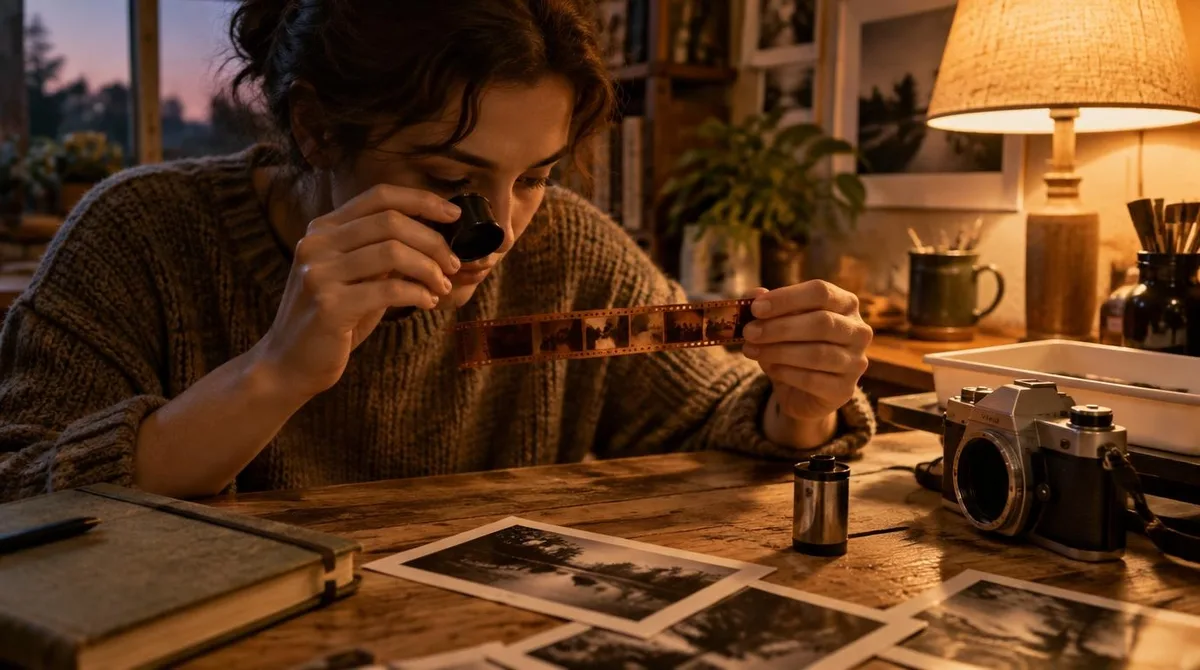
35mm film is the standard still-photography format: a strip about 35 millimeters wide, loaded in a metal or plastic cassette, shot in almost every film camera made since the 1930s. It is the format most beginners should start with, because cameras, labs, and scanners all handle it without fuss. Per Wikipedia's history of 35 mm movie film, the gauge's nominal width refers to strips measuring 1.377 inches (34.976 mm) across — the name is a label, not a measurement.
The verdict up front: 35mm film remains the most practical entry point into analog shooting. It is cheap enough to learn on, flexible enough to grow with, and stocked everywhere. A two-pack of Kodak Gold 200 135/24 film was listed at $20.15 on Amazon's 35mm film listings at the time of writing, and prices move, so check before you buy.
Where did 35mm film come from?
The gauge was born in a movie lab, not a camera shop. According to Wikipedia, William Kennedy Dickson developed 35mm movie film in 1889 at the Edison company, using stock supplied by George Eastman. Dickson took a 70mm celluloid film and simply slit it in half. Four perforations per frame became the accepted international standard gauge in 1909, and the format dominated image origination and projection until digital took over.
That history explains a quirk stills shooters live with: the stills version of the gauge is called 135, and it borrowed the movie strip wholesale. The sprocket holes along the edges are the same perforations a projector used. When you load a roll into a camera, you are handling a format with more than a century of engineering behind it.
What formats does 35mm film come in?
Three broad families matter to everyday shooters, and each behaves differently on the same strip.
- Color negative. The default. Brands like Kodak Gold 200, Kodak UltraMax 400, and Fujifilm 200 produce a negative that labs print or scan easily. Walmart's listings show Ilford HP5 Plus black-and-white 36-exposure rolls at $15.00 and Kodak Ultra MAX 400 at $15.79, which gives you the current ballpark for everyday stock.
- Black-and-white negative. Same mechanics, but you can develop it yourself in a changing bag and a tank, which is why many shooters migrate here once they get hooked. Our darkroom section covers the process.
- Slide (reversal) film. Developed straight to a positive. Less forgiving of exposure error, more expensive per roll, and gorgeous when you nail it.
There is also motion picture stock repurposed for stills, such as the cine films covered in our CineStill 800T guide. Same physical strip, different emulsion pedigree.
How do you choose a film speed?
ISO — the speed number on the box — describes how much light the film needs. Lower numbers mean finer grain and more light required. Higher numbers mean more grain and less light required. That is the whole trade, and it is the single decision that shapes your results most. For related coverage, see Portra 400 Is the Most Forgiving Color Film You Can Buy — That's the Whole Pitch. For related coverage, see Portra 400 Is the Most Forgiving Color Film You Can Buy — That's the Whole Pitch.
- ISO 100–200: bright daylight, landscapes, big enlargements. Slow films reward a steady hand and good light.
- ISO 400: the all-rounder. Fast enough for overcast days and indoors near a window, grainy enough to feel like film. Our Portra 400 guide covers the most forgiving color stock at this speed.
- ISO 800 and up: night, dim interiors, fast action. Grain grows, and so does your freedom to handhold.
What this means in practice: pick one speed and shoot a few rolls of it before experimenting. Speed confusion — not bad cameras — is the most common reason early rolls disappoint.
How does 35mm compare with medium format?
Medium format film is physically larger, typically 120 roll film, so each frame captures more detail and enlarges more cleanly. That is its honest advantage. But 35mm wins on nearly everything else that matters day to day: cheaper rolls, more frames per roll, smaller cameras, faster handling, and labs that process it everywhere. We covered a connected angle in Kodak Portra 160 vs 400: When the Slower Film Wins.
Our analysis: the two formats answer different questions. Medium format asks you to slow down and make fewer, better frames. 35mm asks you to shoot a lot, cheaply, and learn from volume. Most shooters eventually own both, but 35mm is where the habit forms.
What should a new shooter actually buy?
Start with a working 35mm camera and one speed of film. Amazon's current listings show the range of the market: Kodak Tri-X 400 black-and-white 24-exposure 3-packs at $30.25, Fujifilm 200 3-packs at $39.48, and Kodak Portra 400 5-roll bundles at $109.95, per Amazon's 35mm film listings. The everyday stocks cluster around $10 to $15 a roll; the professional stocks run higher.
A sensible first order looks like this:
- One 400-speed color negative film — Gold 200's 400-speed sibling UltraMax, or Fujifilm 400 — for general shooting.
- One 400-speed black-and-white film, such as HP5 Plus or Tri-X, if you want to try home developing.
- A 100-speed film for one sunny day out, to see what fine grain looks like.
Shoot all three, get them developed at the same lab, and compare. That comparison teaches more than any spec sheet.
The bottom line
35mm film earned its staying power the same way it earned its standard status in 1909: it works, it travels, and nearly every lab and scanner on earth speaks its language. The evidence here — the gauge's documented history and the current retail listings — points one way. Buy a 400-speed roll, load a camera that works, and finish the roll before you judge anything. The format has survived every technology that was supposed to replace it. Your first bad roll is just tuition.