Instant film develops itself. Each sheet carries the chemicals that make the picture, which is why Polaroid's integral film, introduced in 1972, could fix a photo with no darkroom, as Wikipedia's instant film entry records. Fujifilm's Instax Mini followed in 1998 and now comes in three sizes.
That single idea explains almost everything about the format. There is no lab, no tank, and no wait that outlasts a coffee. The trade is that the photographer gives up control of the process, so the chemistry gets the final word on color and contrast. For many shooters, that loss is the whole charm. We covered a connected angle in Portra 400 Is the Most Forgiving Color Film You Can Buy — That's the Whole Pitch.
The Pod Does the Developing
Early instant film worked like a tiny factory in the hand. In earlier Polaroid cameras the film is pulled through rollers, which break open a pod of reagent that spreads between the exposed negative and the receiving positive sheet, per Wikipedia's instant film entry. The sandwich then develops on its own, and the photographer peels the sheets apart.
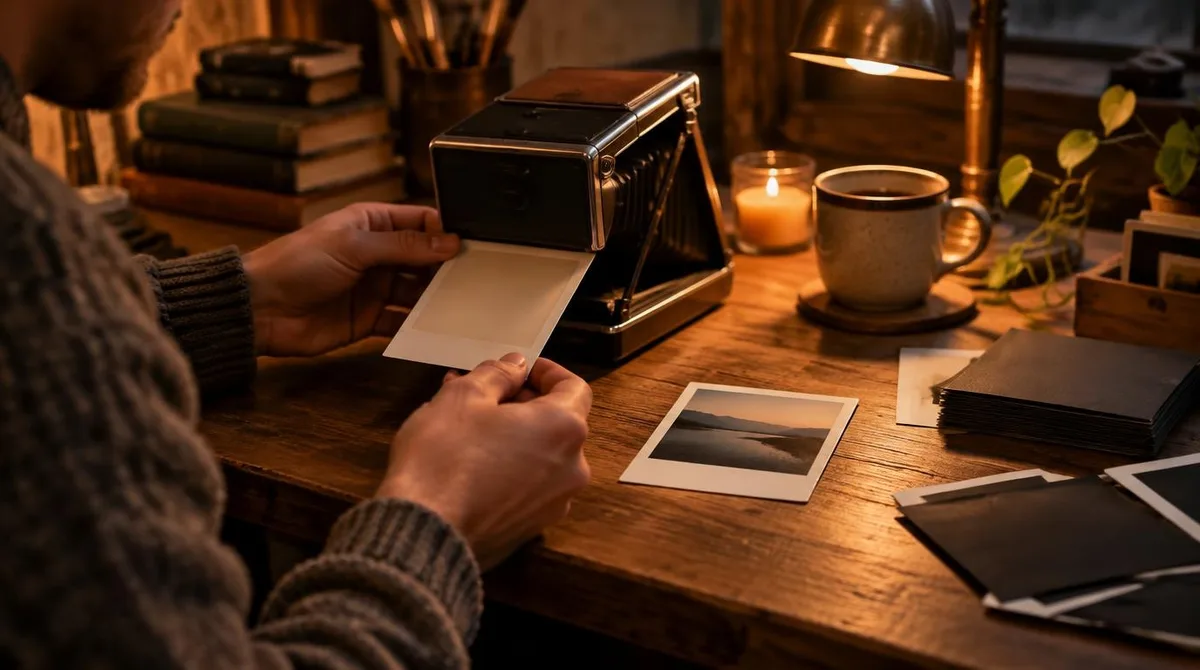
That peel was a small ritual, and the sharp smell of the reagent went with it. The rollers matter to shooters today. If an old folding camera takes this film, dirty rollers leave streaks in the reagent, and every streak shows in the print. A wipe with a damp cloth is the whole service plan.
Integral Film: A Lab in Every Sheet
In 1972 Polaroid moved the darkroom inside the picture itself. Integral film added timing and receiving layers, so the photo develops and fixes on its own with no peeling, as the instant film entry on Wikipedia records. The print that slides out of the camera is the print that lands on the table.
Sizes tell the rest of the story. Instant film has run from tiny 24 by 36 mm frames up to sheets of 50.8 by 61 cm, per the same entry. The everyday consumer size settled at about 83 by 108 mm, border included, which is why a snapshot still slips into a jacket pocket so easily.
Where Instax Fits Into the Family
Fujifilm's Instax line is the modern branch of that family tree. The first camera and film, the Instax Mini 10, went on sale on November 10, 1998, per Wikipedia's Instax entry, with Wide film the next year and Square in 2017. Monochrome versions exist in all three formats, so black and white is not an afterthought. Readers following this should also see Fujifilm Superia 400: Back Again.
The Instax entry on Wikipedia gives the working numbers. Mini film makes a 46 by 62 mm image, Wide makes 99 by 62 mm, and Square makes 62 by 62 mm. The design borrows from Polaroid's SX-70 system, exposing the film through the back of the print and reversing the dye layer order, so the picture seems to bloom in front of the eye.
What the Chemistry Asks of a Shooter
- Keep a developing print face down or shaded, since the first minutes are still part of the process.
- Keep prints out of pocket heat, because warm reagent drifts the color as it settles.
- Wipe rollers on pack cameras between packs, since dried reagent leaves tracks on every frame.
None of this is hard. It is closer to baking than to engineering, a set of small habits that reward patience. The chemistry does the heavy lifting, and the photographer just has to stay out of its way for a few minutes.
Conclusion: Chemistry You Can Hold
Instant film works because the lab travels with the sheet. Polaroid built the idea, integral film made it hands-off in 1972, and Instax keeps it easy in three sizes today, all documented in the entries above. Shoot one pack on an ordinary afternoon and watch a single print change over its first ten minutes. That slow arrival is the format's whole argument, and it still lands in the palm of a hand.