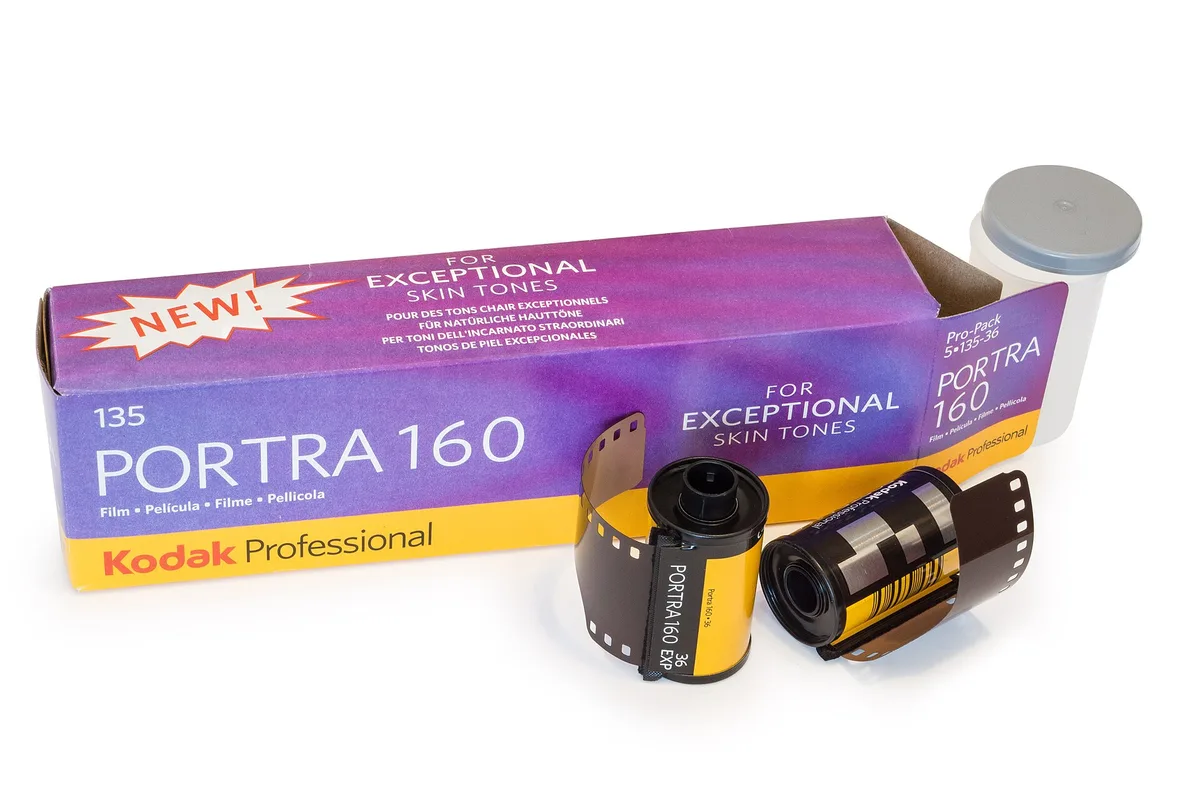
Kodak Portra 800 is the professional answer to the question «what if the reception starts at dusk?» — an ISO 800/30° daylight negative that Kodak positions as its finest-grained 800-speed film, priced at roughly $16-19 a roll as of 2025. It is expensive, it is fast, and when meters dip it is the film professionals reach for.
What does Portra 800 look like when the lights go down?
Like Portra, with the volume nudged up. The family signature holds: warm-leaning but fundamentally neutral skin rendering, gentle contrast, creamy highlight rolloff. What speed changes is texture — grain that is fine for the class, per Kodak's own positioning, yet clearly coarser than Portra 400 — and saturation, which reads slightly deeper and warmer in the shadows than its slower siblings.
In dim mixed light, that warmth becomes an asset. Reception halls, restaurant dinners, and candlelit ceremonies photograph with believable tone instead of the green-gray murk fast consumer films deliver. Blacks stay black, whites stay honest, and the film's shoulder protects white dresses and shirts long past the point where digital sensors have given up.
| Spec | Value |
|---|---|
| Speed | ISO 800/30° (Kodak datasheet) |
| Color balance | Daylight, 5500K |
| Process | C-41 |
| Push support | EI 3200 per Kodak's product documentation |
| Rough price | $16-19 per 36 exposures, as of 2025 |
How much low light can it handle?
Practically: evening interiors, twilight exteriors, stage light, city streets after sunset. Paired with an f/2 lens, Portra 800 holds handheld shutter speeds in venues where Portra 400 is already begging. Twilight cityscapes keep their color for twenty minutes longer than expected. Under daylight it simply behaves like a slightly-grainier Portra, which is why some shooters run it all day and let the speed live in reserve.
ISO 800 also buys depth of field back. Where a 400 film wide open at f/1.4 in twilight might surrender a whole group to blur, Portra 800 stops down to f/2.8 and holds four rows of faces sharp — often the actual difference between a usable frame and a lovely mistake.
The discipline it asks for is metering honesty. Rate it 800, meter the shadows or the face, and the film settles into its intended zone. Underexpose it hard and the palette goes dusky and grain-scarred; this is a film built for the top of its curve, not the bottom.
Can you push it further?
Yes, and with unusual dignity for a color film. Kodak's own product documentation treats a two-stop push to EI 3200 as within bounds, and lab practice agrees: contrast climbs, shadows cool slightly, grain asserts itself, but the palette stays Portra. For genuinely dark rooms this rescue ladder is one of the film's quiet superpowers — a color negative you can lean on like HP5.
The honest alternative is buying light instead of speed: a fast prime lens or a flash does more for a dim wedding than any additional stop of push. But when flash is banned and the moment is already happening, the push ceiling is there, documented by the manufacturer.
What do shooters say about the results?
The professional consensus, consistent across years of published wedding and event coverage, is that Portra 800 renders dim rooms the way clients remember feeling them — warm, flattering, and unbothered by mixed sources. The recurring criticisms are the price, the grain next to Portra 400, and the temptation to burn it in situations 400-speed film could have handled for less money.
Portraiture has always chased this exact property: skin, held faithfully, in light that barely qualifies. If the pursuit appeals historically as well as practically, the Smithsonian's National Portrait Gallery traces a century and a half of photographers solving the same problem with slower and slower tools.
Portra 800 or the alternatives?
Against Portra 400, the trade is grain versus speed: identical color philosophy, one stop apart, roughly half again the price for the 800. Shoot 400 whenever light permits and 800 when it does not — the pairing is standard professional practice precisely because scans from the two films sit comfortably in one gallery.
Against consumer 800s and pushed 400s, Portra 800's advantage is tonal: shadows stay warm-neutral instead of going gray-green, and skin holds saturation instead of blotching. The consumer options cost roughly half as much and give half the palette; for paid work that arithmetic fails, for practice it is perfectly sensible.
Against CineStill 800T — its nearest rival in price and speed — the division is balance: Portra for daylight-balanced faces in mixed rooms, CineStill for tungsten sources and signature glow. Many event bags carry both, split across bodies by the color of the room.
What low-light workflow gets the best out of it?
Meter faces and let backgrounds fall. Portra 800's shoulder protects highlights, so a bright window behind a subject is survivable; a face underexposed in a dim corner is not. Move, meter the skin, and let the room go dark around it — that is the film's native idiom.
Flash discipline changes too. With two extra stops over 400-speed film, fill flash replaces full flash: a low burst lifts eye sockets instead of nuking the ambient, and the room's actual color survives in the background. Photographers who learned flash on 400 film routinely re-tune their power settings the first week on 800.
Scanning needs one honest note: grain is present and scans honestly at resolution. Denoise liberally and Portra 800 loses the texture that distinguishes it from digital; scan clean and enlarge bravely. The film's coarseness is part of the low-light contract.
Who should shoot it?
- Wedding and event pros: the default fast color film for receptions, ceremonies, and dark venues.
- Travel shooters: dusk streets, night markets, and interiors without a tripod.
- Portraitists who like wide apertures in shade: speed buys shutter and aperture freedom.
- Skip it if you shoot mostly daylight — Portra 400 delivers finer grain and similar color for less, and Gold 200 costs half as much again less.
The verdict: Portra 800 is situational spending that behaves like insurance. At roughly $16-19 a roll as of 2025 it is the priciest mainstream color negative on the shelf, and in bright afternoon it is wasted money. The moment the light drops and the faces matter, nothing else in the C-41 cabinet holds the line like it does. Budget it deliberately: two rolls saved for the right rooms beat ten burned in daylight, and the price tag is, functionally, a metering coach. Pair it with a fast prime, tell the lab the truth about every rating, and it repays each dollar. Portra 800 is a professional tool, and it always behaves like one.