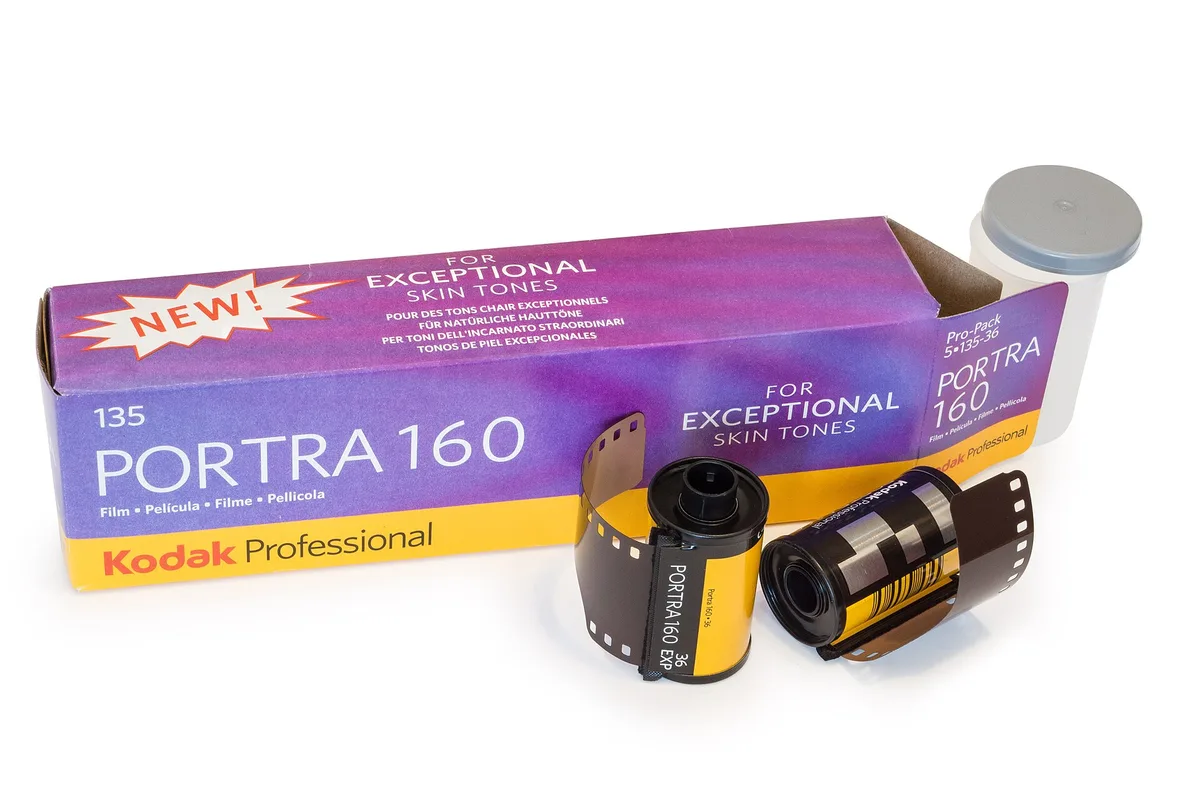
Kodak Portra 400 is the color stock to load first for portraits, with Kodak Tri-X 400 and Ilford HP5 Plus covering the black-and-white work. Portra was made mainly for portrait and wedding applications at its 1998 introduction, per Wikipedia's history, and the family runs in three speeds: 160, 400, and 800.
There is no single portrait film, and the argument over one is missing the point. The working answer is a short list, sorted by a first question: color or no color. Grain, contrast, and the way skin renders all follow from that choice, and every figure below comes from a documented record. For related coverage, see Portra 400 Is the Most Forgiving Color Film You Can Buy — That's the Whole Pitch.
Portra 400: The Color Default
Wikipedia's entry on the Portra family states the intent plainly: daylight-balanced professional color negative films introduced in 1998, aimed at portrait and wedding work. The modern era began in late 2010, when Kodak replaced the older NC and VC varieties with one Portra 400, folded together on a documented assumption: most prints now come from digital scans, so contrast and saturation adjustments happen at the desk. Kodak's own list of improvements, as the entry summarizes it, includes finer grain, better sharpness, naturally rendered skin tones, and improved scanning performance. That last item matters to hybrid shooters; the negative behaves on the scanner as well as in the envelope. Portra 160 followed the same path: Kodak announced the merged version in February 2011, and it has been sold since mid-2011 in 135, 120, 220, and sheet formats, easy to scan according to reviews the entry cites.
Tri-X 400: Black and White With a Temper
For grain that means something, Kodak Tri-X holds the documented ground. Introduced around 1940 in sheet form and released in 35 mm and 120 rolls in 1954, it remains among the fastest black-and-white films available, per Wikipedia's account of the stock. Rated at ISO 400 in standard developers, it pushes to an exposure index of 800 with very good results, and stand development in heavily diluted developers can carry it far higher when a dim room demands it. Wikipedia also records the cultural weight: hand-held cameras plus high-speed Tri-X changed photojournalism, which is why faces on it read as texture rather than polish.
HP5 Plus: The Working Rival
Ilford's answer carries a longer pedigree than most shooters guess. Wikipedia traces the HP line to Hypersensitive Panchromatic plates in 1931, with HP5 Plus as the current version, and names its main competitor outright: Kodak Tri-X 400. The two stocks have shared the documentary market for decades, and either will carry a portrait session. The practical difference lives in how each responds to a chosen developer, and that is where a shooter's own tests belong, honest and repeated, roll after roll.
The Comparison by Real Job
- 1. Color portraits and weddings: Portra 400, documented for that work since 1998 and refined in late 2010 for skin tone and scanning.
- 2. Documentary black and white in mixed light: Tri-X, rated ISO 400 and proven at an exposure index of 800 in standard developers.
- 3. Classic reportage with a long lineage: HP5 Plus, a name running back to 1931.
One more input sits outside the spec list: the shooter's patience. Portra forgives, Tri-X rewards nerve, and HP5 splits the difference. None of the three needs a special camera, only a meter that works and a developer the shooter trusts. Mixed sessions can even pair two of them, one body for color and one for black and white, and the contact sheets settle the debate.
Conclusion: Pick by Job, Then Commit
The comparison settles into three clean choices. Color faces start at Portra 400, whose documented purpose was portraiture from launch. Black-and-white character belongs to Tri-X, with HP5 Plus as the equally documented rival. Load one, finish the roll, and read the negatives; the real comparison happens on the contact sheet, not in a table of numbers. This connects to our earlier piece, Kodak Portra 160 vs 400: When the Slower Film Wins.