Platinum and palladium printing is having another run. The claim that keeps pulling photographers back is permanence: a platinum image can last thousands of years, and the metal sits right on the paper instead of inside a gelatin coat. Few processes survive that test. Fewer still feel this hands-on.
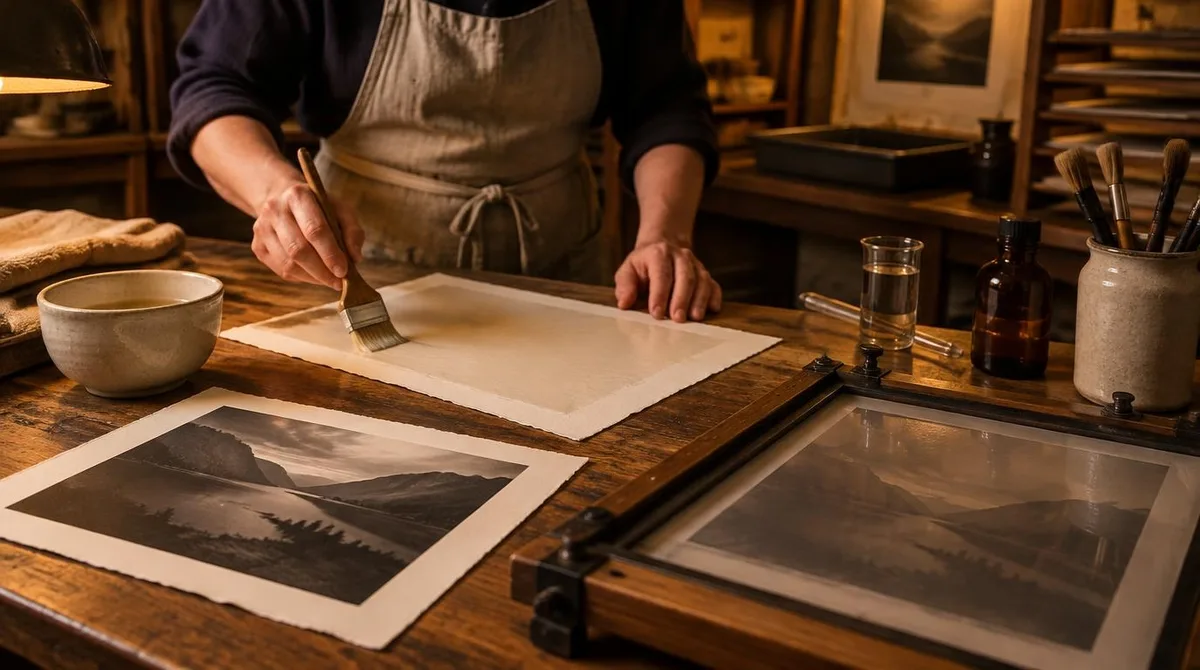
The two metals share one process. The printer hand-coats cotton rag paper with a ferric oxalate solution, dries it, sandwiches it under a full-size negative, and exposes the stack to ultraviolet light. Exposure takes far longer than a silver enlargement, because ferric oxalate reacts to ultraviolet alone. What develops is pure metal held in the paper fibers.
A Process Older Than Most Cameras
The roots reach back further than most film stocks. Ferdinand Gehlen watched light act on platinum in 1830, and Johann Wolfgang Doebereiner found that ferric oxalate boosted the weak reaction a year later. That pairing still runs the bench today. William Willis took out the first platinotype patent in 1873, and his Platinotype Company sold coated paper across Europe and the United States, per Wikipedia's history of the process.
Then the market turned. Wikipedia's figures tell it plainly: the firm booked 273,715 dollars in 1906, roughly 6.5 million in 2009 money, but platinum cost 52 times more than silver by 1907. Eastman Kodak quit making the paper in 1916. The First World War pulled most of the remaining metal into the war effort, and palladium stepped into the gap. Readers following this should also see The Art Market for Film Prints.
Why the Prints Outlive Their Owners
The archival reputation is not sales talk. Platinum group metals resist the reactions that fade other prints, and the same account notes they are more stable than gold. The surface stays matte because no gelatin coats it. The sheet does not curl. Tones run from neutral black through warm black and reddish brown to a blue-black, and the straight-line curve records a negative with fine definition.
One quirk surprises new printers. The deepest tones land lighter than on silver paper, an optical illusion that Wikipedia attributes to the gelatin layer on coated stocks. Wax or varnish a platinotype and its maximum density climbs past a silver print. Character, not defect.
The Palladium Branch of the Family
Palladium entered the picture when platinum got scarce. It prints warmer, reaches blacks with a higher maximum density, and its tonal range runs to a density of 2.1, so it asks for a contrast-rich negative. Rising costs shut the process down around 1930. A handful of photographers have since brought it back, mixing the two metals to split the difference.
Modern workers have one more dial. Richard Sullivan of Bostick and Sullivan coined the Na2 name for the sodium chloroplatinate method, and Dick Arentz published the working formulation in 2002. Small amounts tighten the scale of a palladium print for thin negatives, without the grain that older chlorate restrainers caused.
Why Workshops Keep Filling
Nothing here comes ready-made. Wikipedia states that all platinum and palladium printing happens on paper the printer coats by hand, with a brush or a glass rod. Every variable moves the print: paper brand, humidity, coating stroke, the metal mix. No two prints come out the same, which is either the charm or the problem. This connects to our earlier piece, Why Darkroom Chemistry Sells Out.
That is where teaching benches earn their keep. A workshop compresses years of trial into a weekend of coating, drying, exposing, and clearing. Irving Penn showed the ceiling from 1964 onward, hand-coating his own paper and registering repeat exposures with guides borrowed from graphic arts. Collectors noticed long ago: platinum prints often sell for many times what a similar silver gelatin print brings.
Conclusion: A Slow Craft With a Long Memory
So who should book the bench? If the plan is volume, silver gelatin still wins on speed and cost. If the goal is a print that outlives the photographer, hand-coated platinum or palladium is the documented choice. The chemistry is old, the exposures are long, and the result is metal held in paper fiber.