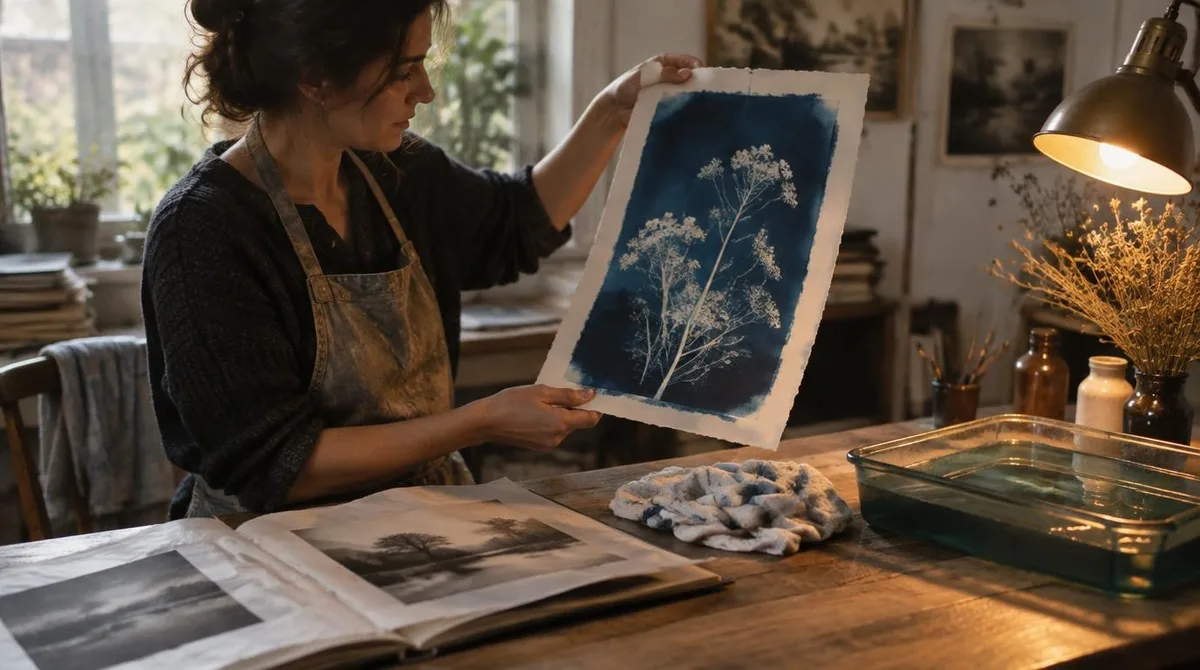
Cyanotype is the blue print that refuses to retire. Sir John Herschel announced the process in 1842, and it still works the same way: two chemicals, sunlight through a negative or an object, then plain water to develop and fix the print, per Wikipedia’s history of the medium. Anna Atkins turned it into a book within a year.
That book matters here. A botanist used a camera-free chemistry set to publish images the world had never seen, and the same simple recipe now fills school art rooms and weekend workshops. The story of how a 184-year-old formula found new fans runs on three facts: easy chemistry, a famous first book, and a teaching revival with numbers behind it. Readers following this should also see The Art Market for Film Prints.
Two Chemicals and a Tub of Water
Wikipedia’s cyanotype entry keeps the recipe short: ferric ammonium citrate, or ferric ammonium oxalate, plus potassium ferricyanide. Nothing else develops or fixes the print; water does both jobs. The paper responds to a narrow near-ultraviolet and blue band, roughly 300 to 400 nanometers, which is why a sunny window does the work of an enlarger.
Herschel published his investigation of light on iron compounds in 1842, and he never patented what he found. Chemist George Thomas Fisher Jr. moved faster than any patent lawyer anyway. His 50-page manual, Photogenic Manipulation, appeared in 1843 with plain instructions, and the next year it came out in German and Dutch translations.
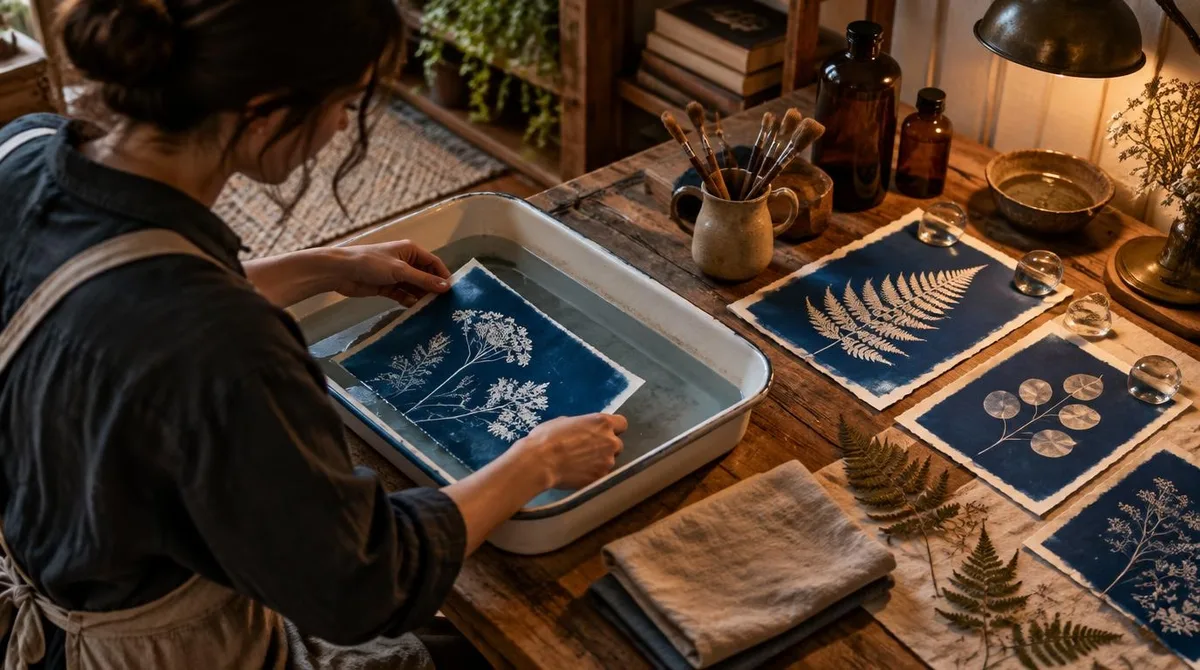
The wash is the gentle part. Rinsing the paper in water clears the unexposed chemicals and sets the image, and the same entry notes that intensifying and fixing happen in that single bath. A process a child can run without a darkroom was never going to stay rare.
Anna Atkins Printed the First Book
Atkins was a botanist, and the process suited her specimens. Over 1843 to 1861, with help from Anne Dixon, she hand-printed albums of plants and textiles, including Photographs of British Algae: Cyanotype Impressions. Her Wikipedia entry calls her often the first person to publish a book illustrated with photographic images.
She printed without a camera. Ferns, algae and seaweeds sat on coated paper, and the sun drew their silhouettes. The groundwork ran in the family: her entry adds that she received an unusually scientific education for a woman of her time, with a father, John George Children, known as a chemist. John Mercer pushed the format further in the 1850s, printing photographs onto cotton and toning the blue toward violet, green, brown, red or black, per the same history.
Why Classrooms Picked It Back Up
The numbers show the revival. Since 2000, about 10 books a year appear in English with cyanotype in the title, compared with 95 in the whole stretch from 1843 to 1999, per Wikipedia. The number of artists working in the process has grown along with the books.
Teachers like the low barrier, and the record prints make the point loudly. In 2017 Stefanos Tsakiris created a 276.64 square meter cyanotype in Thessaloniki, Greece, a world record sized to teach people the process, per the same entry. Scale draws a crowd: in 2001 Robin Hill showed a 30.5 meter cyanotype wrapping a Soho gallery in New York. Architects had kept the chemistry alive all along, through engineering blueprints that stayed dominant until the 1940s.
Conclusion: Blue Is a Door, Not a Deadline
The cyanotype process rewards exactly the people who think film is fussy. There is no camera to load and no lab to trust: coat paper, lay out a negative or a leaf, give it sun, then rinse. Atkins used that freedom for science, Mercer pulled it toward fabric and color, and classrooms now use it as a first step into photographic chemistry. Try it on a bright afternoon with a fern from the park. The worst result is a bad print in a color nobody else has, and the rinse water is the only darkroom required. This connects to our earlier piece, Why Darkroom Chemistry Sells Out.